

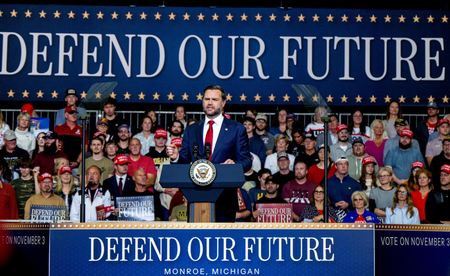
Washington, Oct 18 (IANS) US Vice President JD Vance has defended his controversial description of some H-1B visa workers as indentured servants, saying his criticism was directed at American companies that exploit foreign employees and not at the immigrants themselves.
In a CBS News town hall in Flat Rock, Michigan, Vance acknowledged that his language on immigration had sometimes been imperfect. He also invoked his wife Usha Vance’s Indian heritage and her parents’ journey from South India while defending the Trump administration’s immigration policies.
The exchange came when Niv Agaram, a naturalised American citizen who said he had immigrated to the United States about 20 years ago, challenged Vance over his description of H-1B workers and the administration’s immigration enforcement.
Agaram said he had voted for the Trump-Vance ticket because of concerns about border security, drug trafficking and human trafficking. But he questioned whether the administration’s approach was making Americans safer.
Vance responded by acknowledging concerns about his choice of words.
“And, and to the extent that my rhetoric has been imperfect here, that’s on me,” he said.
He explained that his earlier remarks concerned certain H-1B visa arrangements rather than everyone entering the United States through the skilled-worker programme.
“When I say an indentured servant, that’s not a criticism of the H-1B visa holder, that’s a criticism of a company,” Vance said.
He argued that employers sometimes recruit foreign workers after dismissing Americans, leaving the incoming employees dependent on their employers for their continued presence in the country.
Unlike American citizens, he said, foreign workers could face consequences extending beyond losing their jobs if they challenged their employers.
“I think that gives employers way too much power,” Vance said.
He maintained that the problem lay in a visa system that could leave workers vulnerable to exploitation, rather than in the individuals seeking employment and opportunities in America.
Vance also criticised companies that claimed they could not find qualified American workers while simultaneously dismissing existing employees.
He argued that such practices harmed both domestic workers and immigrants.
The discussion then turned to broader concerns about anti-immigrant rhetoric.
Vance referred to his own family while explaining that he believed the United States could welcome immigrants without abandoning restrictions on immigration.
“I love my, my mother-in-law and father-in-law, who immigrated from South India, and obviously their daughter, born in the United States of America, is now the second lady and I’m very proud of her and I, and I love her very much,” he said.
Pressed by moderator Tony Dokoupil about the perceived dehumanisation of immigrants, Vance said he did not intend to portray immigrants negatively.
He nevertheless argued that rapid immigration could undermine social cohesion and change communities in ways that some existing residents found difficult.
Vance said immigration policy needed to balance humanitarian responsibilities, opportunities for newcomers and the interests of American citizens.
The H-1B programme allows American employers to recruit foreign professionals for specialised occupations. Indian nationals have historically accounted for the largest share of its beneficiaries, making changes to the programme particularly significant for India’s technology workforce and Indian-American families.
–IANS
lkj/ksk/uk