
Washington, July 24 (IANS) The proposed India-Middle East-Europe Economic Corridor (IMEC) received strong bipartisan backing during a US congressional hearing on the future of the Abraham Accords, with lawmakers and policy experts describing the project as a strategic alternative to China’s Belt and Road Initiative that could slash transit times between India and Europe by more than half while reshaping regional economic cooperation.
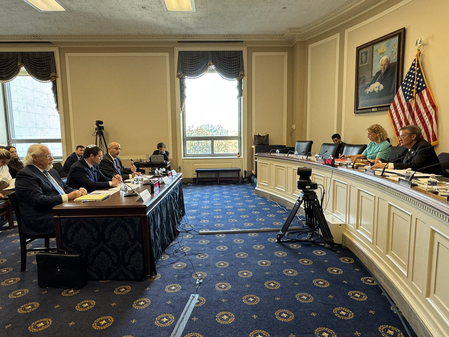
At a hearing of the House Foreign Affairs Subcommittee on the Middle East and North Africa, witnesses repeatedly highlighted IMEC as one of the most consequential initiatives to emerge from the broader regional integration effort, arguing that the United States should take a more active role in advancing the corridor from concept to implementation.
Asher Fredman, Executive Director of the Misgav Institute for National Security and a visiting fellow at The Heritage Foundation, called IMEC “one of the most consequential infrastructure projects of this generation.”
“IMEC could become one of the most consequential infrastructure projects of this generation shortening transit times between India and Europe by approximately 51 percent, supporting strategic east west natural gas and digital infrastructure and creating a US-aligned zone of economic growth which serves as an alternative to the Chinese Belt and Road Initiative,” Fredman told lawmakers.
He said Congress should direct the US International Trade Commission and the Department of Commerce to study the corridor’s economic impact and prepare an actionable roadmap identifying investment opportunities, commercially viable projects and customs harmonisation measures to facilitate the smooth movement of goods from India to Europe.
“The United States should also convene an IMEC leaders forum and establish a standing secretariat to enhance accountability,” he said.
Former US Ambassador to Israel Daniel Shapiro, another witness, said IMEC had become one of the key regional initiatives that followed the Abraham Accords and remained strategically relevant despite recent instability in the Middle East.
He noted that repeated disruptions in the Strait of Hormuz underscored the importance of alternative trade and energy routes.
“The repeated closure of the Strait of Hormuz since March reinforces the value of alternative energy routes and expanded infrastructure, a core pillar of IMEC and similar efforts, and should energize near-term focus and investments on the infrastructure of that corridor,” Shapiro said.
Committee Chairman Mike Lawler warned against proposals that could exclude Israel from the project, saying the corridor’s original design depended on regional cooperation.
“Recent reporting shows some officials are proposing to remove Israel from existing plans to develop an India-Middle-East-Europe Economic Corridor, known as IMEC,” Lawler said.
He added that Israel had been “a critical piece of the puzzle connecting Saudi Arabia and Greece” and disclosed that he had written to Secretary of State Marco Rubio urging the administration to ensure Israel remained part of the initiative.
Responding to Lawler, former US Ambassador to Israel David Friedman said IMEC and similar connectivity projects were “integral to a more peaceful and cooperative Middle East.”
“I think these are important steps where I think Congress, as the keeper of the purse, has a real role to play,” Friedman said.
“I would encourage Congress to always be looking for ways to create better economic opportunities. That is, of course, in most cases, how peace is born.”
During the hearing, Fredman also acknowledged that political hurdles remained before IMEC could become fully operational.
“Even today, Saudi Arabia will not allow goods destined for Israel originating in Israel, to cross its territory,” he said. However, he argued that Saudi Arabia’s ambition to become “a global logistics and transportation hub” could eventually help remove those barriers.
He suggested the United States could help finance new rail infrastructure linking Saudi Arabia and Israel, saying such investments “would be good for American companies, for American technologies, and it would be good for making IMEC a reality.”
For India, IMEC is regarded as a flagship strategic connectivity project that could significantly reduce shipping times to European markets, diversify supply chains and strengthen economic ties with West Asia and Europe. It has also become an important pillar of the expanding India-US strategic partnership and is widely viewed as a rules-based alternative to China’s Belt and Road Initiative.
–IANS
lkj/rs