
UN losing legitimacy as outcome of 80-year-old war continues to define it: India

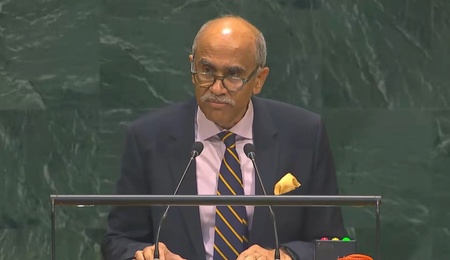
United Nations, Oct 23 (IANS) The outcome of a war that took place 80 years ago cannot continue to define today’s UN that is losing its legitimacy as it clings to an unrepresentative Security Council, India has said.
“No war, especially one that took place over 80 years ago, should determine today’s state of the world”, India’s Permanent Representative P Harish told the General Assembly on Thursday.
“The authority derived from a victory eight decades ago cannot compensate for the deficit in legitimacy of an unrepresentative Security Council today”, he said.
While the nominal winners of the war monopolise the permanent membership of the Council, he pointed out that India’s massive contribution helped them win.
“Around 2.5 million Indians took part in the war and around 90,000 of them died in military service”, he said. “Over 4 million were killed in the infamous Bengal famine due to colonial war policies”.
Some want to ignore or suppress this fact, he said.
“An organisation crafted of the victors, for the victors and by the victors did not, obviously, care to include the concerns of the victims”, he said.
The privileges written into the Charter by the victors of 1945 gives some countries the procedural means to resist change, he said.
But this cannot be used to stall the intergovernmental negotiations (IGN) for reform indefinitely by preventing the adoption of a text for the discussions, a timeline or direction, he said.
A small group of countries headed by Italy of which Pakistan is a member, has used procedural manoeuvres to prevent the adoption of a negotiating text which is necessary to move the reform process forward.
The group that calls itself Uniting for Consensus (UfC) asserts that there must be a consensus before a negotiating text is adopted.
“We remain baffled by this inversion of the sequence of negotiation process”, Harish said because “in any multilateral process, a text is the precondition to a negotiation and not its conclusion”.
“The IGN cannot be fundamentally different from other UN processes, in which negotiations proceed on the basis of a text”, he said.
–IANS
al/rs