

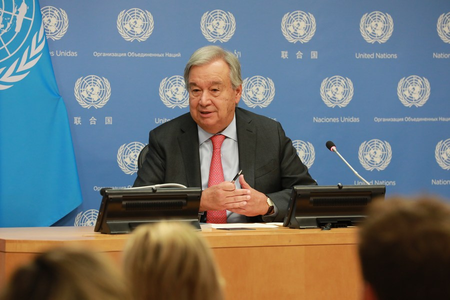
United Nations, June 27 (IANS) UN Secretary-General Antonio Guterres has called for harnessing technology to stop drug cyber-trafficking, working with police and authorities to detect and disrupt criminal networks and the manufacture of synthetic drugs, and boosting investment in prevention, harm-reduction and treatment.
On Friday (Local time), in his message on the International Day against Drug Abuse and Illicit Trafficking, observed annually on June 26, Guterres said illicit drug trafficking is not a victimless crime, “it inflicts profound harm on people and communities around the world while fuelling violence, crime and instability.”
The UN chief said the proliferation of synthetic drugs and the growth of online trafficking networks are compounding the crisis, while fragile health systems, persistent treatment gaps and limited access to support are undermining efforts to reduce stigma and address drug use disorders.
Noting this year’s theme challenges the world to forge solutions grounded in foresight, innovation and solidarity, he called on the international community to “recommit to the bold, innovative and evidence-based solutions this scourge demands.”
In its World Drug Report 2026, released Friday, the UN Office on Drugs and Crime (UNODC) said drug traffickers are exploiting technologies and global instability to introduce novel drugs, experiment with different trade routes and methods, and aggressively push into new markets, reports Xinhua news agency.
“We have seen an unprecedented spike in new types of drugs on the market, and worryingly, some are more potent or dangerous than before,” said UNODC Executive Director Monica Juma. “And, we are already suffering the impact: millions of premature deaths and healthy years of life needlessly lost; drug trafficking networks that are distorting economies; the destruction of lives, communities and livelihoods; and the compounding of insecurity and violence.”
According to the report, an estimated 331 million people used a drug in 2024, which represents 6.2 per cent of the global population aged between 15 and 64, compared to 5.2 per cent in 2014. Cannabis remained the most widely used drug by far (256 million users) in 2024, followed by opioids (63 million), amphetamines (32 million), cocaine (25 million) and ecstasy (21 million).
The report found that illicit drug manufacturers continue to invent new synthetic drugs in attempts to skirt regulations and avoid detection, with five times more drug types found in seizures in 2024 than before 2000.
The increasing availability of novel synthetic opioids such as fentanyls, nitazenes and orphines on the market suggests that traffickers continue to search for alternatives to heroin, and a turn away from plant-based opiates toward synthetics could cause a permanent shift in the global opioid market, with ramifications on how these drugs are used and the harms therein, the report said.
The report showed that new trafficking routes and the gradual spread of methamphetamine production have created new markets for the drug, notably in the Near and Middle East, Africa and parts of Europe.
Cannabis production, trafficking and use are all evolving, likely in part due to the ongoing changes in perception toward the drug around the time when many jurisdictions, notably in North America, adopted legalisation and/or decriminalization policies, according to the report.
Drug use can be associated with acquisitive crime, violence within families and social groups, and victimisation of — and by — those who use drugs, the report said. But these outcomes are also influenced by wider factors, such as the context of the drug use and the personal histories of the people involved, including poverty, homelessness, poor mental health and contextual factors in the community, such as a potential lack of access to drug treatment and social services, the report noted.
–IANS
sd/