
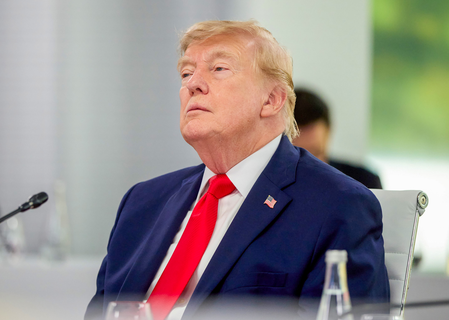
Evian, June 16 (IANS) President Donald Trump on Monday praised the leaders of the United Arab Emirates and Qatar for helping secure a new agreement with Iran, using separate meetings with the two Gulf allies to underscore what he described as a diplomatic breakthrough that would prevent Tehran from obtaining a nuclear weapon and restore stability to a region shaken by weeks of conflict.
Meeting UAE President Sheikh Mohammed Bin Zayed Al Nahyan and later Qatari Emir Sheikh Tamim bin Hamad Al Thani on the sidelines of international gatherings in Evian, Trump repeatedly credited both countries with supporting the negotiations that led to the accord.
“We just signed a deal with Iran, and this country was very, very — a very powerful ally and good things are happening,” Trump said during his meeting with Sheikh Mohammed.
Trump said shipping traffic through the Strait of Hormuz had already begun to recover.”The ships are starting to move now. We’re going to have a — fully open by Friday,” he said. “Oil is starting to go, and the prices are coming down rapidly.”
He added, “Most importantly, Iran will not have a nuclear weapon.”
Sheikh Mohammed thanked Trump for backing regional allies during the recent conflict and said U.S. support had been crucial.
“Thank you for your support, your commitment to your friend, to your allies,” he said. “Without your support, your commitment, Mr. President, not only my country, but the Middle East would be a different situation today.”
The UAE leader said there were “a lot of things we can talk about for going forward between our two countries, how we can make our relationship even better.”
In a separate meeting with Qatar’s Emir, Trump again highlighted the Iran nuclear deal and praised Doha’s role in the negotiations.
“We have our deal done with Iran and, uh, it should be successful,” Trump said. “We have a deal that’s a fair deal. It’s a good deal.”
He thanked Qatar for standing with the United States during a tense period in the region.
“Working with Qatar and the people of Qatar, uh, was really a pleasure,” Trump said. “You fought, and you helped us and with great bravery.”
The Qatari Emir described the agreement as “a very important deal” and said momentum should be maintained.
“There’s still a lot of work to be done, but I think, you know, with this momentum, if we continue like that, Mr. President, I think we can achieve and do great in the region,” Sheikh Tamim said.
He added that the agreement would be “very important for the region, very important also for Iran as well.”
Throughout both meetings, Trump stressed that the central objective of the agreement was ensuring that Iran could not obtain a nuclear weapon.
Asked about the contents of the accord, Trump said he would eventually release the text publicly.
“I’ll probably have a press conference and read it to you word by word,” he said during the UAE meeting.
“Here’s what it says: Iran will never have a nuclear weapon.”
At the Qatar meeting, Trump repeated the same message.
“The one thing that’s happening that’s of note, frankly, the only thing that really matters to me is Iran will never have a nuclear weapon,” he said.
Trump also suggested that regional diplomacy could advance further following the agreement. During the UAE meeting, he expressed optimism about expanding the Abraham Accords.
“I think they’re all going to come in,” he said when asked whether additional countries could join the normalisation framework.
Both meetings also highlighted the expansion of economic ties between Washington and its Gulf partners. Trump said the UAE had invested “trillions of dollars” in the United States, while the Qatari Emir said bilateral trade and investment ties were growing rapidly.
“Our trade partnership is gonna reach $1.2 trillion,” Sheikh Tamim said.
The UAE and Qatar played significant diplomatic roles during efforts to reduce tensions following the recent conflict involving Iran and its regional adversaries. Both countries maintain channels of communication across the Gulf and have frequently acted as intermediaries during periods of heightened regional tension.
–IANS
lkj/dan