
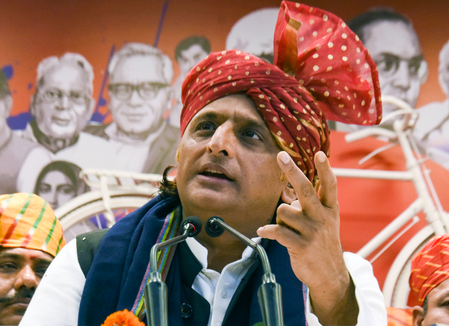
New Delhi, May 23 (IANS) Samajwadi Party (SP) chief Akhilesh Yadav appears to be recalibrating the expanded form of an acronym he coined earlier, with an eye on the Assembly elections in Uttar Pradesh next year.
“PDA” – a term he is said to have had formulated to represent “Pichda” (backward), Dalit (oppressed), and Alpsankhyak (minority) – widening the earlier “MY” (Muslim-Yadav) formula that was largely seen as representing the SP vote bank.
It was assumed that the new acronym would project SP as a champion for the oppressed without alienating its MY base. However, as several reports suggest, a section of Yadavs have since shifted allegiance owing largely to what is being seen as the party’s apparent pivot more towards minorities.
Meanwhile, recent elections, especially in Bihar and West Bengal, have shown women voters playing a decisive role in the outcome. This large “other half” of electors has stood firmly with the National Democratic Alliance (NDA) or its principal component, the Bharatiya Janata Party (BJP) itself.
There now appears to be a conscious effort at rewriting PDA with an “A for ‘aadhi aabadi’ (half of the population)” narrative.
Following last year’s Bihar poll results, the SP chief posted a message on ‘X’ that redefined his PDA. “The victim is the PDA,” he wrote, adding, “In today’s BJP regime, we stand with full commitment in support of the demands of our neglected and oppressed ASHA worker sisters in every way. Why is the BJP government backing away from their economic security and social security? When the government has money to squander on BJP’s false propaganda and lifeless statues, is the basis for discrimination against ASHA workers simply that they come from exploited, deprived, impoverished backgrounds, or that they are half of the population included in the PDA — meaning women — don’t they have the right to live with dignity?”
The post is now “pinned” on Yadav’s X handle. This month, soon after a West Bengal mandate overwhelmingly favoured a BJP government for the first time, Yadav urged the Union government to implement the Women Reservation Act, 2023, that provides a one-third quota for women in Parliament and Assemblies.
He reportedly added that his party would continue to raise the issue till the Act is implemented. The SP has played a complex role in women’s empowerment; while it has launched notable welfare schemes in Uttar Pradesh during its rule, the party’s stance in Parliament on the Women’s Reservation Bill has often been questioned.
The SP demanded a separate reservation for Muslim women, arguing that they are socially and economically backward and underrepresented. If OBC and SC women receive quotas, Muslim women should also have a distinct share, its leaders stressed.
Though the NDA pointed out that religion-based reservation is unconstitutional, and that many Muslim sub-castes already fall under OBC categories, the SP remains unconvinced. This stance has been perceived by some analysts as not just legislative but also an electoral strategy ahead of the 2027 UP Assembly elections, aimed at consolidating Muslim votes.
Another attempt by the NDA was defeated in Parliament this year since the government does not enjoy the support of two-thirds of Lok Sabha members. The BJP has been highlighting the issue of the Opposition’s reluctance to support women’s empowerment.
Incidentally, SP, along with Lalu Yadav’s Rashtriya Janata Dal (RJD), and other regional allies, opposed the Women’s Reservation Bill even during the Congress-led United Progressive Alliance (UPA) regime. It had then demanded “quota within quota” for OBC and minority women. This opposition delayed the Bill’s passage for decades.
It successively stalled multiple attempts at legislation – in 1996 by the H.D. Deve Gowda government, in 2008 and 2010 during the UPA regime, again in 2013–2014, always insisting on separate quotas for OBC and Muslim women. However, in 2023, when the NDA government reintroduced the Women’s Reservation Bill (Nari Shakti Vandan Adhiniyam), Yadav supported reservation in principle but demanded clarity on the backward, Dalit, minority, and tribal women’s share.
And, in 2026, the SP, aligning with the Opposition, voted against the Constitution (131st Amendment) Bill, citing it as being linked to delimitation.
–IANS
jb/skp