

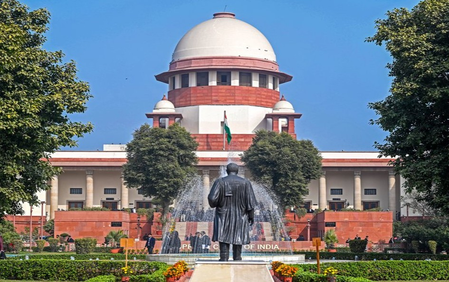
New Delhi, May 7 (IANS) The Supreme Court on Thursday expressed concerns over excessive judicial intervention in matters of religion, orally observing that indiscriminate challenges to religious practices before Constitutional courts could disrupt the civilisational fabric of India.
A nine-judge Constitution Bench headed by Chief Justice of India (CJI) Surya Kant was hearing arguments in the Sabarimala reference matter, which involves broader constitutional questions concerning the scope of religious freedom, denominational rights under Articles 25 and 26, and the extent of judicial review over religious practices.
During the hearing, Justice B. V. Nagarathna remarked that religion remains deeply intertwined with Indian society and cautioned against courts routinely entertaining challenges to religious practices.
“Once everyone starts questioning certain religious practices or matters of religion before a constitutional court, then what happens to this civilisation, where religion is so intimately connected with Indian society? There will be hundreds of petitions questioning this right, that right, opening of temple, closure of the temple,” Justice Nagarathna orally observed.
She further said that the Constitution Bench was conscious that any ruling delivered in the matter would have implications “for a civilisation” and not merely for individual disputes.
“What is unique about India? We are a civilisation despite having so much plurality and diversity. One of the constants in our society is the relationship between human beings and religion. We cannot break that constant,” Justice Nagarathna added.
In a similar vein, Justice M. M. Sundresh remarked that indiscriminate judicial scrutiny of religious disputes could destabilise religions themselves. “Everybody will question everything. Every religion will break,” Justice Sundresh orally observed.
The apex court was hearing submissions advanced by senior advocate Raju Ramachandran, appearing for the Central Board of Dawoodi Bohra Community, challenging the power of the Dai, the religious head of the Dawoodi Bohra community, to excommunicate members.
Ramachandran argued that the power of excommunication had allegedly been exercised arbitrarily in several cases, resulting in social ostracism and “civil death” of individuals.
He contended that such practices violated fundamental rights under Articles 21 and 25 of the Constitution.
“We are a civilisation under a Constitution, and therefore nothing which goes against the grain of the Constitution can be countenanced in a civilised society governed by the Constitution,” the senior counsel submitted.
According to Ramachandran, excommunication affects not only religious participation but also the social and secular life of individuals, including marriage, employment and access to community spaces.
The 9-judge Bench, however, repeatedly questioned the extent to which Constitutional courts could adjudicate competing claims arising within religious denominations.
Justice Ahsanuddin Amanullah orally observed that if courts begin examining proportionality in matters carrying “even a slight tinge of religion”, the protection guaranteed under Article 26 could itself stand diluted.
The Constitution Bench also examined issues relating to female genital mutilation (FGM) in the Dawoodi Bohra community after submissions by senior advocate Siddharth Luthra, who argued that the practice violated bodily integrity, dignity and penal law protections.
During the hearing, Justice Amanullah expressed strong reservations over attempts to equate FGM with male circumcision, remarking, “What are you talking! Get your facts clear. It is just the opposite.”
Justice Joymalya Bagchi also observed that circumcision of the penis could not be equated with genital cutting involving the clitoris.
The nine-judge Bench, also comprising Justices Aravind Kumar, A.G. Masih, Prasanna B. Varale and R. Mahadevan, will continue hearing the matter next week.
–IANS
pds/dan