Result-driven partnership with India making unprecedented headway: Italian envoy

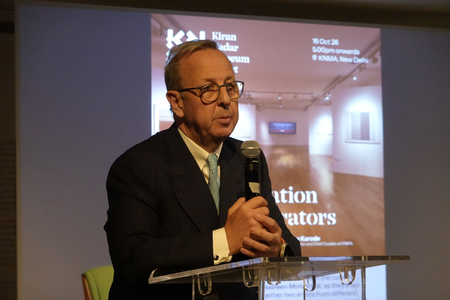
New Delhi, Oct 22 (IANS) Hailing growing ties with India, Italian Ambassador to India, Antonio Bartoli, on Thursday said that the two nations have a “result-driven partnership” which continues to make an “unprecedented headway”.
Bartoli described the chemistry between Prime Minister Narendra Modi and his Italian counterpart Giorgia Meloni as “important” while participating in NDTV World Summit’s session titled ‘The West, Rewired: The New Transatlantic Order’ along with European Union Ambassador Jean-Eric Paquet, Australian High Commissioner Philip Green and German Ambassador Jasper Wieck.
“It’s a very result-oriented partnership because the chemistry between leaders is important and also helps Ambassadors. But, it is necessary not sufficient and I think that the positive side is that there are objective converging interests. We were talking about connectivity. That’s a matter of fact. We are two peninsulas and so we are interested in connecting the respective seas, and because you want to develop, strengthen your manufacturing base and we are the second industrial powerhouse in Europe,” Bartoli commented when asked about the evolution of India-Italy Special Strategic Partnership over the recent years.
“We have a roadmap that identifies all the areas and we have monitoring mechanism, be that trade, we have the objective of 20 billion by 2029, be that investments and things are moving… And, then defence, space, energy, security, mobility, this is another converging interests not only with Italy, but with Europe, because, of course, there is a win-win, and people-to-people. And that’s why the two Prime Ministers, for example, decide to have next year as the year of culture and tourism in both countries. So I think it’s a very result-driven partnership, and we are making unprecedented headway,” he added.
Highlighting India’s growing diplomatic presence, Bartoli said that New Delhi is no more a “spectator” and has already moved from non-alignment to multi-alignment and from passive to active role. He also stressed that the Ukraine conflict cannot be dismissed as a European problem.
Asked whether he sees an increased Indian role in peacemaking efforts, Bartoli said, “We certainly assist to a growing role of India. As you said in your introduction, no more a spectator. Already from non-alignment to multi-alignment is from passive to active and I think that that comes with a greater role, come also greater responsibilities. So, we very much welcome these higher profile because, what’s happening is that in a period we were all enthusiastic about globalisation and we thought that that would bring more peace and more democracy. The result is not there. But, what is happening is that the effects of what happens in the world is immediately globalised.”
“So there is a profound interconnection between, for example, the conflicts we are confronted with and one cannot dismiss, for example, the Russian aggression, the war in Ukraine as a European problem, only because of geography. For the reasons that we were mentioning before, that this undermines the very foundations of the international order, but because that has an impact, a concrete impact also on the wallets of our consumers. So, you cannot isolate and say that it’s just a Ukraine war that is causing the rise in fuel because it’s also Iran, even more, that is doing that. So, I think that there is more awareness of this interconnection, as I think this interconnection is part also of the proposed solution. So, in a way, connecting, for example, the shortage of food because of the lack of a fluid passage of food through the Black Sea, for example, and the choke point, enormous and possibly in Bab el-Mandeb. So, all this is interconnected and affects everyone,” he added.
During the discussion, Australian High Commissioner Philip Green voiced concern over China’s military build-up, naval deployments and test firing of the intercontinental ballistic missiles which land near the small island states of the southwest Pacific. He stated that Australia cooperates with China where it can, disagrees where it must and always acts in its national interest.
“I don’t think I’m in a position to give advice to others, but let me explain where we’ve come to. As you said, we had a period of economic deadlock with China. USD 20 billion worth of trade was wiped off Australia’s boards in a week. A whole lot of goods that we used to sell to China were no longer available. That was difficult for us, but it wasn’t impossible. Something like 96 per cent of that trade actually found different markets and in a way, we became more resilient and resolute as a result. What’s our policy on China? There are many things on which we can cooperate. Trade is mostly a very fertile avenue for Australia and China cooperating,” he said.
“There are many issues in the world, in our region, including climate change, where we need China’s cooperation. But through our period of stabilisation, we have been clear about areas where we disagree with China. We are worried about China’s military build-up, the fastest military build-up of any country anywhere in the world since the Second World War. We’re concerned about Chinese naval deployments, including those that come to the Tasman Sea between Australia and New Zealand, undertake live firing operations without adequate warning. And when we see China test firing intercontinental ballistic missiles which land near the small island states of the southwest Pacific, we have questions that need to be answered. In short, with China we cooperate where we can, we disagree where we must and we always act in our national interest,” the Australian High Commissioner added in his remarks at the NDTV World Summit.
–IANS
akl/as