Pune, Pimpri-Chinchwad, and PMR region to become India’s major mobility hub by 2030: Maha CM Fadnavis

Pune, Nov 3 (IANS) Maharashtra Chief Minister Devendra Fadnavis on Tuesday expressed confidence that with a robust network of modern transport facilities—including the metro, electric buses, inner ring roads, outer ring roads, tunnels, and a new airport—being developed across Pune, Pimpri-Chinchwad, and the Pune Metropolitan Region (PMR), the region will emerge as a major mobility hub of the country by 2030.
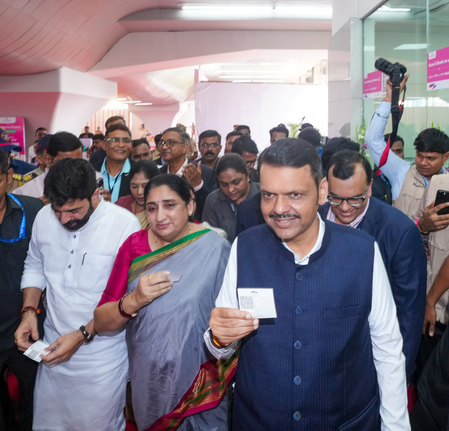
He was speaking at an event after Prime Minister Narendra Modi virtually inaugurated Mann-Hinjawadi to Shivajinagar Line-3 and laid foundation stone for the Pune Metro Phase-2.
“Hinjawadi and its surrounding areas form a critical IT hub in India, visited daily by thousands of employees who often face heavy traffic congestion, losing one to two hours of their time. The launch of the Metro will bring immense relief to IT professionals, particularly the youth,” the Chief Minister said.
He expressed joy that the project, whose foundation stone was laid by Prime Minister Modi in 2018, was now being dedicated to the nation by him as well.
The Shivajinagar-Hinjawadi corridor is the country’s first Metro project implemented through a Public-Private Partnership (PPP) model. Built by Tata Projects and Siemens on a DBOT (Design, Build, Operate, and Transfer) basis, the project reached completion with the cooperation of the Central and state governments, viability gap funding (VGF), and land acquisition facilitated by the Maharashtra government.
Acknowledging the vital contribution of women from construction to operations, the Chief Minister noted that this ‘Pink Powered’ metro symbolises the active participation of women power.
Around 120 kilometers of metro lines have been developed in Pune, with work ongoing on several other corridors.
Maharashtra has been a major beneficiary of the country’s metro expansion, with metro systems operational or under construction across 12 municipal corporation areas.
“The Metro is not merely a transport facility but an engine driving economic development, fostering investments, employment, and surrounding economic ecosystems,” the Chief Minister said.
To develop the Pune Metropolitan Region into a major urban growth centre, the Central government has provided a fund of Rs 5,000 crore, which will be utilised to build modern transport infrastructure in Pune and the PMR. Developed as a ‘Green Metro’, Pune Metro will generate 30 per cent of its required energy independently.
“With the comprehensive network of metro lines, electric buses, inner and outer ring roads, CMTR (Common Mobility Transport Route), underground routes, and tunnels taking shape, Pune is poised to become a key centre not only for IT and manufacturing but also for frontier technologies, contributing significantly to the national economy,” CM Fadnavis said.
Emphasising that the Central government under Prime Minister Modi prioritises poverty eradication and youth employment alongside infrastructure development, the Chief Minister expressed hope that Maharashtra will continue to receive the Centre’s steadfast support and guidance.
Deputy Chief Minister Eknath Shinde said that the metro will play a pivotal role in easing traffic congestion in Pune and making citizen commutes faster, safer, and more comfortable.
Metro Line-3 is a game-changing project for Pune’s public transport network that will reshape the city’s future and resolve daily commuting challenges.
Terming the metro an historic Diwali gift to the residents of Pune, Deputy CM Shinde commended the state government’s track record of keeping its promises and executing projects on time, reflecting Maharashtra’s rapid developmental strides.
Pune Metro Line-3 is India’s first metro project executed under a PPP model using the DBFOT framework under the National Metro Rail Policy 2017.
The Deputy CM congratulated the Pune Metropolitan Region Development Authority, Maha-Metro, Tata Projects, Siemens, and all concerned officials for completing the project on a mission mode.
Highlighting women’s substantial participation in building and operating the metro, Eknath Shinde remarked that this project reaffirms that women are second to none in any field.
“The Mumbai-Pune Expressway has significantly boosted Pune’s growth, and the upcoming ‘Missing Link’ project will further reduce travel time between the two cities, alongside the development of a ring road encircling Pune. These projects will collectively ease traffic congestion and bring immense relief to citizens, making Pune’s mobility more dynamic and seamless,” the Deputy CM said.
He also made a special mention of the late Deputy Chief Minister Ajit Pawar’s enduring contributions to Pune’s development.
Citing initial scepticism regarding public ridership when the Metro was first launched, Eknath Shinde noted that more than nine million passengers have chosen the Metro so far, underlining its popularity as a comfortable, time-saving transit option that strengthens public transport.
The state government remains firmly committed to making Pune a congestion-free, modern city, he added.
Deputy Chief Minister Sunetra Pawar said that given Pune’s rising population and transportation demands as a cultural, educational, and industrial hub, building a modern, safe, and eco-friendly public transport system is imperative.
Pune Metro Line-3 is India’s first metro corridor executed through a PPP, completed at a cost of around Rs 8,313 crores.
“Notably, it will be the country’s first 100 per cent women-operated metro line, with around 100 women train pilots and 50 per cent of station staff being women—a matter of immense pride,” Deputy CM Sunetra Pawar added.
The foundation stone for this corridor was laid by Prime Minister Modi in 2018.
The Union Cabinet has also approved four extended corridors under Phase-2, the foundation stone for which was laid on Tuesday. These 31-kilometer, 28-station corridors, cleared by the Central government at an estimated cost of Rs 9,858 crore, will connect areas such as Vanaz to Chandani Chowk, Ramwadi to Vitthalwadi, Kothrud, Bavdhan, Viman Nagar, Kharadi, and Wagholi. Once completed, the total Pune Metro network will exceed 100 kilometers.
“Stations like the R.K. Laxman Museum and Savitribai Phule Pune University on this route will pay tribute to the ideals of the ‘Common Man’ and Krantijyoti Savitribai Phule, respectively,” Sunetra Pawar noted.
The late Deputy Chief Minister Ajit Pawar made invaluable contributions from the inception of every Detailed Project Report (DPR) to its final approval.
As Finance Minister, he ensured necessary fund allocations and personally reviewed the progress of Hinjawadi metro stations in July, instructing officials to maintain high quality and adhere to timelines.
A special task force under the leadership of the District Collector has been constituted to address infrastructure needs in Hinjawadi, Mann, and Marunji, covering roads, transport, water, electricity, waste management, and metro connectivity.
Approvals worth Rs 426 crore have been granted for internal approach roads leading to metro stations, and as Guardian Minister, she would closely oversee the execution of these works, she assured.
Minister of State Murlidhar Mohol described the inauguration of the metro and the groundbreaking of new lines as a historic milestone for Pune’s development.
The 23-km Hinjawadi-Shivajinagar route will expand the Pune Metro network to 55 km, benefiting IT employees and millions of citizens.
In September alone, 9,58,603 passengers travelled via Pune Metro, cementing its status as the city’s lifeline.
“The foundation stone was also laid on Tuesday for nearly 46 km of new routes—namely Khadakwasla–Kharadi, Vanaz–Chandani Chowk, Ramwadi–Wagholi, and Manikbaug–Nal Stop—which will strengthen connectivity across the eastern, western, and southern parts of the city and help ease traffic congestion,” he said.
–IANS
sj/khz