
New Delhi, May 19 (IANS) Prime Minister Narendra Modi’s recent visits to the Netherlands and Sweden constitute part of India’s wider European outreach, which includes Norway and Italy, at a time of shifting alliances in the geopolitical landscape amid the dramatic change in US foreign policy under Donald Trump’s presidency.
“Underlying the trip is a larger geopolitical calculation on both sides. Europe is seeking to reduce its economic exposure to China and cope with the fallout of the Russia–Ukraine war, which has forced a rethink of energy security, supply chains, and defence relations. India, for its part, wants to diversify away from dependence on any single bloc, attract high‑quality investment, and secure technology partnerships that support its rise as a manufacturing and innovation hub,” an article in India Narrative said.
Indian commentators have described the tour as “reshaping India’s strategic ties with Europe”, noting that agreements in the Netherlands, investment talks in Sweden, and the Nordic summit in Norway together project India as Europe’s most trusted democratic partner in Asia.
The focus on semiconductors, defence, clean energy, and long‑term industrial collaboration suggests both sides are thinking beyond short‑term deals towards building durable and resilient value chains, the article stated.
It highlights that a central, forward‑looking piece of the Dutch leg is semiconductors. The Netherlands is home to ASML, the world’s leading manufacturer of advanced lithography machines used to produce cutting‑edge chips, and Indian officials see collaboration with ASML as vital for the India Semiconductor Mission. One of the visit’s outcomes was a key step for a semiconductor fab project in Gujarat’s Dholera, underlining how this diplomacy connects directly to India’s domestic manufacturing ambitions.
The article underscored that the strategic roadmap also includes agreements on critical minerals, seen as essential for clean energy technologies and advanced manufacturing, thereby helping India secure inputs for batteries, electronics and renewable‑energy infrastructure. Cooperation in green hydrogen, maritime security, and a long‑standing Strategic Partnership on Water reflects Dutch strengths in ports, water management and climate‑resilient infrastructure.
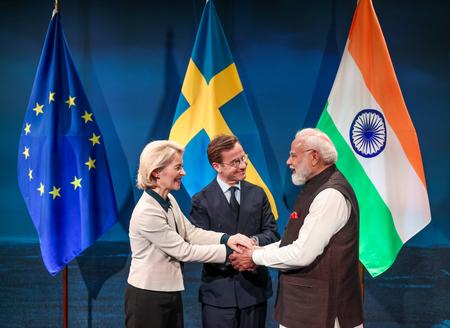
From the Netherlands, PM Modi travelled to Sweden’s Gothenburg, where he met Swedish Prime Minister Ulf Kristersson and European Commission President Ursula von der Leyen.
PMs Modi and Kristersson agreed to elevate India–Sweden ties to a Strategic Partnership and launched several initiatives: Joint Innovation Partnership 2.0 and an India–Sweden Technology and Artificial Intelligence Corridor. They also set an ambitious target of doubling bilateral trade in the next five years. Indian officials described the visit as reflecting a growing “strategic convergence” on trade and investment, innovation‑led growth, trusted partnerships for resilient supply chains, defence cooperation and the green transition, the article stated.
Ultimately, the visits to the Netherlands and Sweden show how India is using targeted bilateral partnerships to give real substance to its broader engagement with the EU and the Nordic region. By tying together high‑tech collaboration, green transition, defence, cultural diplomacy and diaspora outreach, New Delhi is betting that deeper ties with innovative, mid‑sized European powers can amplify its global influence and support its domestic transformation at the same time, the article observes.
–IANS
sps/vd