

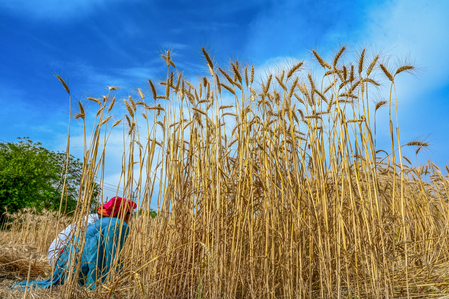
Mumbai, Nov 26 (IANS) Amid severe drought conditions, Maharashtra has recorded Rabi sowing over 15.69 lakh hectares as of November 23, accounting for 27 per cent of the five-year average Rabi cultivation area of 57.80 lakh hectares, excluding sugarcane, according to a crop situation review presented at the state cabinet meeting held on Wednesday.
Sowing is lower than 25.99 lakh hectares, or 45 per cent of the average sown by November 23 in the previous year. Pre-sowing tillage operations are in their final stages across the state, while sowing of gram (harbhara), wheat, safflower (kardai), and maize is underway.
Early-sown Rabi jowar and other crops are currently between germination and seedling stages, said the presentation made by the agriculture department. On the other hand, Maharashtra dam water storage has fallen to 62 per cent, down from 90 per cent last year in as many as 3,042 dams.
In one year, Maharashtra has lost 407.93 TMC of live storage — a fall of 28 percentage points. The situation has worsened since the last Cabinet review on November 17, when storage was 923.60 TMC (64 percent). In eight days, the state has lost another 29.60 TMC, said the presentation made by the water resources department.
As of November 23, total Rabi Cereals were sown on 8.30 lakh hectares against a five-year average of 30.66 lakh hectares reaching 27 percent of average (compared to 44 percent last year), Rabi Jowar 5.13 lakh hectares or 34 per cent of the 14.96 lakh hectare average (vs. 55 per cent last year), Wheat 1.69 lakh hectares or 14 percent of the 11.81 lakh hectare average (vs. 26 per cent last year), Maize 1.43 lakh hectares or 38 per cent of the 3.75 lakh hectare average (vs. 56 per cent last year) and other Rabi Cereals (bajra, oat, barley, etc.): 4,321 hectares sown, or 30 per cent of the 14,548 hectare average, total Rabi Pulses 7.23 lakh hectares out of a 26.44 lakh hectare average, standing at 27 percent (vs. 47 per cent last year).
Further, Gram (Harbhara) was sown on 7.02 lakh hectares, accounting for 28 per cent of the average area of 25.17 lakh hectares, compared with 47 per cent during the corresponding period last year. Other Rabi pulses, including moong, urad, matki, popti and lentil, were sown on 20,437 hectares, representing 16 per cent of their average area of 1,27,552 hectares.
According to the presentation, sowing of total Rabi Foodgrains was done on 15.52 lakh hectares against a 57.10 lakh hectares average (27 percent vs. 45 per cent last year) and total Rabi Oilseeds on 16,563 hectares out of a 70,077 hectares average, reaching 24 per cent (vs. 26 percent last year), led by safflower (12,159 hectares or 40 per cent of average).
Sowing progress varies widely across administrative divisions as of November 23, 2026. On the input front, data up to November 21, 2026 show total estimated seed availability of 17,22,327 quintals against a requirement of 11,60,091 quintals (for a 63.99 lakh hectare target), with 5,09,567 quintals supplied so far.
For fertilisers, against an approved Rabi planning of 31.10 lakh metric tonnes (LMT), total seasonal availability stands at 23.36 LMT, seasonal sales at 3.83 LMT, and stock as of November 23 at 19.53 LMT.
Meanwhile, the water resources department said that state-wise stress is deepening. At 62 per cent, Maharashtra enters the rabi season and summer months with over one-third of its live storage capacity empty, compared to only 10 per cent empty last year.
Marathwada (Chhatrapati Sambhajinagar division) is in a critical situation at 34 percent, with Dharashiv, Jalna, Beed, Latur and Parbhani districts in single digits.
According to the presentation, small dams are most vulnerable. Minor projects, which sustain villages, are at 36 percent. This points to pressure on local drinking water and rabi irrigation in the coming months. Cities are relatively safer but lower.
Pune, Nashik and Konkan divisions and the Mumbai-Thane system remain above 71 per cent, but all are 8-19 percentage points below last year. Storage fell from 64 percent to 62 percent between November 17 and 25, indicating continued drawdown without replenishment.
–IANS
sj/srk/skp