

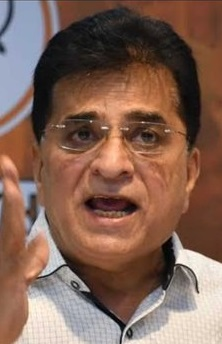
Mumbai, Aug 17 (IANS) Former BJP MP Kirit Somaiya, in a letter to the Chief Electoral Officer of Maharashtra, S. Chockalingam, alleged major contradictions in electoral data released by election officials regarding form distribution, untraceable voters, and death-related deletions in Mumbai during the Special Intensive Revision (SIR) of the voters’ list.
Somaiya, who uploaded the letter dated August 16 on X on Monday, highlighted discrepancies between claimed form distribution rates and reported untraceable voters across the city’s districts. Urging immediate review, Somaiya requested the Chief Electoral Officer’s attention and necessary corrections to resolve these discrepancies.
“State election officials declared a distribution rate of over 99 per cent across Maharashtra. Specifically, the Mumbai City Collectorate reported 99.99 per cent form distribution, while the Mumbai Suburban Collectorate reported 99.96 per cent. Simultaneously, data from the Collectorates, District Election officials, and the Mumbai Municipal Commissioner’s office reveals that 11.73 per cent of voters in Mumbai Suburban and 9.72 per cent in Mumbai City District remain untraceable. Somaiya questioned how near-100 per cent distribution could occur when around 12 per cent of addresses or voters cannot be traced,” said Somaiya in his letter.
The letter also pointed out significant disparities in electoral roll deletions due to death across different constituencies comprising Mankhurd: 2.91 per cent, Anushakti Nagar: 2.6 per cent, Mahim: 7.72 per cent, Byculla: 6.71 per cent and Shivadi: 6.26 per cent.
Somaiya’s letter comes days after Chockalingam shared updated metrics on the SIR.
Across the state, details for over 1.8 crore voters (about 18.46 per cent of the electorate) remained categorised as “uncollectable”.
Mumbai accounts for a significant portion of the uncollected data, with nearly 30.8 lakh voters (approx. 29.6 per cent of the electorate across Mumbai City and Suburban districts) listed in this category. High proportions of uncollectable entries were noted in constituencies undergoing large-scale redevelopment or containing high migrant populations (such as Sion Koliwada, Mankhurd-Shivaji Nagar, Worli, Malabar Hill, and Mumbadevi).
The Chief Electoral Officer explained that the “uncollectable” status primarily applies to electors under the ASDD categories — Absent, Shifted, Dead, or Duplicate. He noted that higher rates of uncollectable entries in urban hubs like Mumbai and neighbouring Thane are standard compared to national trends due to frequent address changes, migration, and daily commuting patterns.
The CEO emphasised that having uncollected status during household enumeration does not mean a voter is permanently excluded without recourse. While untraced entries will not appear on the initial draft electoral list, electors and Booth Level Agents are encouraged to submit the required forms to ensure legitimate eligible voters are properly updated or included.
–IANS
sj/dpb