
Karnataka govt celebrates Kempegowda Jayanti; CM Shivakumar launches 15-lakh sapling plantation drive

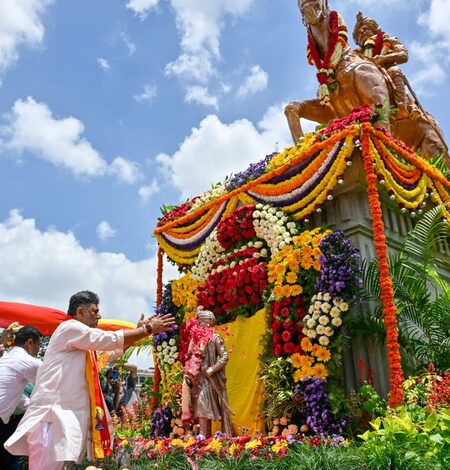
Bengaluru, June 27 (IANS) Karnataka Chief Minister D.K. Shivakumar on Saturday led the 517th Kempegowda Jayanti celebrations by paying floral tributes to the 108-foot ‘Statue of Prosperity’ of Nadaprabhu Kempegowda near Bengaluru International Airport and announcing a drive to plant 15 lakh saplings across Bengaluru in honour of the city’s founder.
He said the initiative reflects Nadaprabhu Kempegowda’s vision of sustainable urban development and environmental conservation.
The Chief Minister offered floral tributes to the bronze statue of Nadaprabhu Kempegowda at Devanahalli. Adichunchanagiri Seer Nirmalanandanatha Swamiji, Nanjavadhuta Swamiji of Spatikapuri in Sira taluk and Vishwa Vokkaligara Mutt Seer Nischalanandanatha Mahaswamiji were present on the occasion. CM Shivakumar later visited the theme park developed adjacent to the statue.
Addressing the gathering, Shivakumar extended Kempegowda Jayanti greetings to the people of the state and said it was a privilege to remember the visionary leader whose ideals continue to guide Bengaluru’s growth.
“The programmes have been designed keeping in mind Kempegowda’s vision, values and administrative principles. Along with the tree plantation drive, we have organised a marathon and taken up a comprehensive development project for Kempegowda Fort at Magadi at a cost of Rs 100 crore,” he said.
Chief Minister Shivakumar said the government has initiated the process of acquiring 10 acres of land around Kempegowda’s memorial at Magadi and has already purchased five-and-a-half acres.
Shivakumar said the government has instructed the Airport Authority to prepare a plan to introduce visitors arriving in Bengaluru to Kempegowda’s legacy by creating suitable facilities near the trumpet interchange leading to the airport.
“We want everyone coming to Bengaluru to know about the founder of the city. The Airport Authority has been asked to prepare a detailed plan and submit it to the government,” he said.
He recalled that the government had earlier allotted five acres of land near Sumanahalli for the construction of Kempegowda Bhavan and had also proposed establishing a Town Planning College in Kempegowda’s name.
While appreciating the previous BJP government for constructing the iconic 108-foot statue, Shivakumar said it was not clearly visible to travellers heading to the airport. He said discussions had been held with the seers and Minister Krishna Byre Gowda, following which the Airport Authority had been asked to take appropriate steps to improve its visibility.
The Chief Minister said greenery around the statue had been significantly enhanced compared to last year and added that the completed theme park would be inaugurated shortly. He also welcomed the Airport Authority’s decision to maintain the theme park.
Announcing a new initiative, CM Shivakumar said Kempegowda Jayanti would no longer be confined to Vidhana Soudha and would instead be celebrated in all 28 Assembly constituencies of Bengaluru over the next 28 years. He added that directions had also been issued to celebrate the occasion across all Assembly constituencies and at the ward level throughout the state.
Highlighting Bengaluru’s rapid growth, Shivakumar said the city now has a population of nearly 1.40 crore and around 1.30 crore registered vehicles. He said the government aims to provide Metro connectivity to the airport within a year and is planning to expand Bengaluru’s Metro network to nearly 500 kilometres over the next two years.
Describing Kempegowda as a leader whose legacy belongs to all communities, Shivakumar said the celebrations were not limited to any one caste but were intended to promote the founder’s vision, governance model and commitment to the holistic development of Bengaluru.
It can be noted that, Nadaprabhu Kempegowda I (c. 1513–1569) was a 16th-century chieftain and visionary administrator widely regarded as the founder of modern Bengaluru. A feudatory of the Vijayanagara Empire, he founded the city in 1537 by constructing a mud fort and developing planned markets, residential areas, lakes and temples.
Kempegowda is credited with introducing systematic urban planning, building an extensive network of tanks (lakes) for water conservation, and promoting agriculture, trade and civic infrastructure. He also erected the famous four watchtowers that marked the city’s boundaries, reflecting his long-term vision for Bengaluru’s growth and expansion.
–IANS
mka/rad