

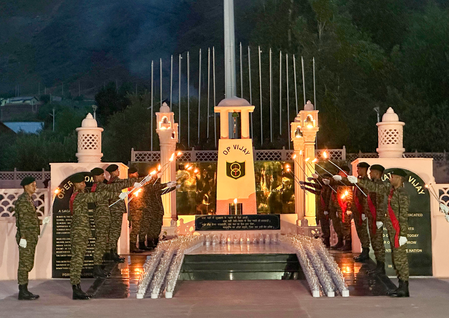
New Delhi, July 25 (IANS) On July 26, India observes the 27th anniversary of Kargil Vijay Diwas, commemorating Operation Vijay of 1999 when the armed forces evicted Pakistani infiltrators and reclaimed the strategic heights of Kargil. The victory not only secured the frontier but also reshaped India’s security doctrine and national consciousness.
It was a turning point, and Kargil Vijay Diwas permanently transformed India’s national security doctrine, foreign policy, military structure and also domestic consciousness. There are many lessons that the national security planners learnt from this operation carried out by the Indian armed forces.
While the operation was a major success, it also exposed critical gaps in intelligence, surveillance and inter‑service coordination. This led to the formation of the Kargil Review Committee. To ensure proper coordination between the Army, Air Force and Navy, the committee had suggested the creation of the post of Chief of Defence Staff (CDS).
The Narendra Modi government in 2019, in a landmark decision, created the post of CDS to ensure tri‑service integration between the Army, Navy and Air Force. The Department of Military Affairs (DMA) too was established to streamline decision‑making between bureaucrats and military officials.
India also went on to upgrade its intelligence capabilities by creating the Defence Intelligence Agency (DIA). With this came the expansion of satellite and drone‑based border surveillance to prevent strategic surprises in the future.
Another key lesson learnt during Operation Vijay was that India faced restricted access to global military technologies and hardware. India had learnt the hard way, and this led to the push towards Atmanirbharta or self‑reliance.
An aggressive push was made towards indigenous manufacturing. Under the current framework, domestic defence production scaled to Rs 1.78 crore while defence exports reached Rs 38,424 crore. Indigenous equipment is now being supplied to over 80 countries.
India also ensured that it transformed its Border Security and Warfare Doctrine. The earlier practices of vacating high‑altitude posts during the peak winter were abandoned by the Indian Army. The Line of Control (LoC) was transformed into a permanently manned and heavily fortified frontier.
An official said that the doctrine has completely shifted from a reactive defence to a policy of proactive, punitive retaliation against terror. This was an important shift, and India saw this in action during Operation Sindoor, the official added.
This proactive shift in dealing with terror was also visible during the Balakot air strikes to avenge the Pulwama attack and the surgical strikes carried out in the aftermath of the Uri terror attack.
India gained immense respect when it was decided to successfully evict intruders while also ordering the armed forces not to cross the LoC. Further, India managed to globally isolate Pakistan diplomatically. Even traditional allies of Pakistan stopped supporting intrusions by state‑sponsored terrorists.
India also managed to call out Pakistan’s nuclear bluff. This was amplified during Operation Sindoor when the armed forces carried out an operation that mainly targeted terror infrastructure.
On the other hand, Western nations began to view India as a responsible and mature nuclear power in the region.
The Kargil war was also the first televised war. It brought live combat footage and the realities of the frontline directly to the television screens of citizens. This was a crucial move as it created a wave of national solidarity.
The national sentiment towards the Indian armed forces soared, and the people recognised the supreme sacrifices of Captain Vikram Batra, Yogendra Singh Yadav, Manoj Kumar Pandey and several other brave men.
Officials say that when it comes to Pakistan, it is a continuous affair as their doctrine of bleeding India by a thousand cuts will not change. However, India has a new doctrine when it comes to battling the terror proxy war. An act of terror will no longer be considered as a cross‑border strike, but as an act of war.
The official said that Operation Vijay was a major success. There were pitfalls and setbacks, no doubt. However, India has come a long way today, and many lessons have been learnt, the official also added.
–IANS
vicky/dan