India’s defence exports rise from Rs 1,000 crore to Rs 39,000 crore: Rajnath Singh

Vadodara, June 30 (IANS) Defence Minister Rajnath Singh on Tuesday said India’s defence exports had risen from around Rs 1,000 crore in 2014 to approximately Rs 39,000 crore, attributing the increase to reforms aimed at expanding domestic manufacturing and encouraging private sector participation.
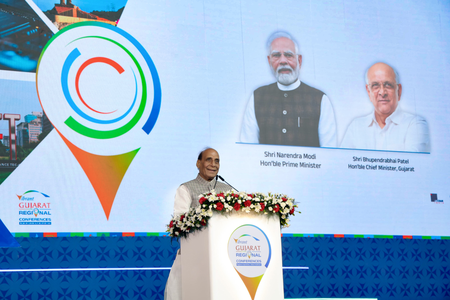
Speaking at the valedictory session of the Vibrant Gujarat Regional Conference (VGRC) in Vadodara, Singh said the country’s defence industry had undergone major changes over the past decade.
“There was a time when India depended heavily on other countries to meet its defence requirements, importing much of what it needed. But today, India is rapidly moving forward in the fields of defence manufacturing and exports,” he said.
The minister said domestic defence production had also increased significantly during the same period.
“If I speak in terms of figures, in 2014 our domestic defence production was approximately Rs 46,000 crore. Today, you will be pleased to know that our defence production has increased to Rs 1.78 lakh crore,” he emphasised.
Singh said the growth had been supported by indigenous platforms, increased private-sector participation, and the emergence of start-ups.
“The success of indigenous platforms, the growing participation of the private sector and the new energy brought by start-ups have together created a strong defence ecosystem in India,” he said.
He said initiatives under the Atmanirbhar Bharat campaign, together with Make in India, the Defence Acquisition Procedure and the Technology Development Fund, had strengthened domestic capabilities in aerospace and defence.
The minister said provisions for modernisation and capital procurement in the Union Budget were intended to encourage domestic industries and integrate them into global supply chains.
Despite the increase in production and exports, Singh said the government viewed the current achievements as only the beginning. “However, I believe this is only the beginning. We still have to go much further,” he added.
He said Gujarat would play an important role in supporting the next phase of growth due to its industrial infrastructure, skilled workforce, and entrepreneurial ecosystem.
Singh pointed to the state’s expanding semiconductor ecosystem in Sanand and Dholera and said future economic and strategic competition would increasingly depend on advanced technologies. “I believe that both future warfare and the future economy will run on chips,” he said.
He added that artificial intelligence, quantum computing, cybersecurity and space technology would also become increasingly important in strengthening India’s defence capabilities.
Singh reiterated that India’s pursuit of self-reliance did not imply economic isolation. “We wholeheartedly welcome collaboration with foreign Original Equipment Manufacturers. We also encourage technology transfer and joint ventures. However, our endeavour is always to ensure that the real benefits accrue on Indian soil, to the people of India, and that India’s own capabilities are built here,” he said.
He concluded by urging industrial partners to support India’s self-reliance mission and said the country aimed to develop products designed and manufactured in India that would meet domestic requirements while serving international markets.
–IANS
mys/dan