

New Delhi, May 22 (IANS) West Bengal Chief Minister, Suvendu Adhikari’s meetings with Prime Minister Narendra Modi, Home Minister Amit Shah, and Defence Minister Rajnath Singh in New Delhi are significant – both politically and strategically.
Politically, it can largely be linked to an imminent state Cabinet expansion – as the Adhikari government currently comprises only five ministers – apart from addressing other administrative issues.
Strategically, the highlight of the “double engine” government lies in its focus on the porous Bangladesh border and the highly sensitive Siliguri Corridor in north Bengal.
The ceremony for Adhikari’s swearing-in at Kolkata’s Brigade Parade Ground on May 9 as head of the state’s first BJP government was attended by the three top decision-makers in the Union government, signaling strong central backing.
The BJP’s decisive victory in West Bengal, winning 207 seats against the Trinamool Congress’ 80 in the 294-strong Assembly, has reshaped the political landscape, aligning the state more closely with New Delhi’s national security priorities.
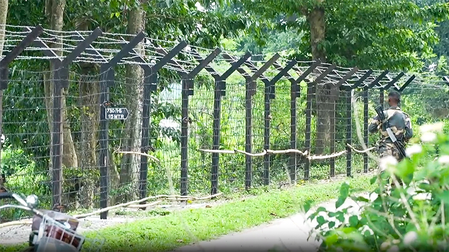
West Bengal shares a 2,216 km border with Bangladesh, much of which is porous and witness to infiltration, smuggling, and illegal migration.
Land transfer to the Border Security Force (BSF) for border fencing was pending for years, allegedly due to political resistance under the previous government.
Adhikari’s Cabinet has now approved the transfer of 600 acres of land to the BSF, promising completion within 45 days. In fact, border fencing started the same week that the state government began the formal handing over of portions of land to the BSF, according to on-ground reports coming on Friday.
The porous border and a lack of political will had rendered districts like Malda, Murshidabad, and North 24 Parganas exposed to infiltration, which on occasions included insurgent movements, and large-scale smuggling.
Thus, border fencing was critical to check cross-border crime and enhance national security.
Of particularly strategic importance is the Siliguri Corridor to the north of the state, which is approximately 20-22 km wide at its narrowest point, thus being given the term ‘Chicken’s Neck’.
It is of vital importance, connecting mainland India to the northeastern states. Any disruption here could cut off the Northeast entirely. Beijing – which unreasonably claims Arunachal Pradesh as part of its territory – has long been aggressively eyeing this region.
It failed in an attempt at gaining proximity through the apparent development of Jhapa industrial park in Nepal. The previous KPS Oli-led Communist government had signed a memorandum to allow Chinese personnel and machines gain strategic access to land lying close to the North Bengal border.
The project was subsequently shelved by the Balendra Shah government, reportedly over administrative and financial issues.
Now, Beijing is trying a route via the Teesta water management initiative with Bangladesh, which analysts see as a way to gain leverage near the corridor.
A World War-II airbase at Lalmonirhat in north Bangladesh, close to the Teesta project site, has reportedly since been witnessing increased activity.
These moves reflect Beijing’s strategy of encirclement, using economic projects to gain influence in India’s vulnerable borderlands.
By influencing Nepal and Bangladesh, China seeks to pressure India in the Siliguri Corridor, a choke point for military logistics. And all this time, land acquisition for BSF to set up a fence was allegedly stalled under the previous regime due to political sensitivities and concerns on farmer displacement.
The BJP government has reversed this stance, prioritising border security over local politics, aligning with Prime Minister Modi’s national security agenda.
Several reports of illegal migration, cattle smuggling, and narcotics trafficking have been coming from these border districts, some of which are being probed by Central agencies.
Adhikari’s two-day high-level meetings in the national Capital thus underscore a unified approach — fencing, Intelligence sharing, and security preparedness, along with facilitating administration.
–IANS
jb/rad