

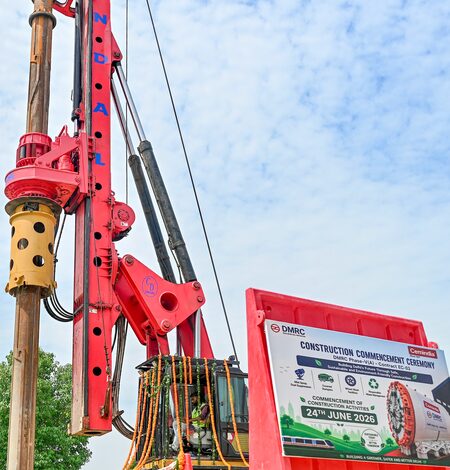
New Delhi, June 24 (IANS) The Delhi Metro Rail Corporation (DMRC) on Wednesday said it has started construction work at the Central Secretariat Metro Station for the Central Vista Corridor in the heart of the national capital.
Union Minister of Housing and Urban Affairs, Manohar Lal, was present on the occasion along with senior officials from the ministry and DMRC.
The station is being developed under Phase V(A) as an extension of the existing Magenta Line from Janakpuri West to RK Ashram Marg. The Central Secretariat station will become a triple interchange station, where the new Magenta Line station will seamlessly connect with the existing Yellow Line and Violet Line. This unique facility will significantly benefit government employees and commuters accessing the Lutyens’ Zone and surrounding administrative districts.
The corridor spans 9.913 km with nine underground stations, namely Shivaji Stadium, Yuge Yugeen Bharat, Central Secretariat, Kartavya Bhawan, India Gate, War Memorial–High Court, Baroda House, Bharat Mandapam, and Indraprastha.
This project marks a significant step in strengthening connectivity to the heart of New Delhi, providing efficient access to major government offices, judicial institutions, national memorials, and convention facilities, while enhancing overall network efficiency and passenger convenience.
The Magenta Line (Line-8) of Delhi Metro network is set to emerge as the longest corridor of the Delhi Metro, featuring the highest number of interchange stations and underground stations, thereby significantly enhancing cross-city connectivity across the National Capital Region (NCR).
Total length of Magenta Line, from Botancial Garden to Inderlok, will be approximately 89 kilometres, making it the longest corridor in the Delhi Metro network. The line will function entirely as a driverless metro corridor once fully operational.
Once completed, the magenta line from Botanical Garden to Inderlok will have 65 stations, out of which 40 will be underground stations. The extensive interchange facilities of the Magenta Line are expected to reduce travel time, decongest major corridors, and provide seamless, end-to-end connectivity across the city.
The Magenta Line is also distinguished by hosting two significant engineering landmarks of the Delhi Metro network. Haiderpur Badli Mor, located on this corridor, is the highest elevated Metro station in the system (Rail level height of approximately 28.362 metresat Pier no 340), while Hauz Khas, also on the Magenta Line, is the deepest underground Metro station (at about 29 metres).
These milestones highlight the corridor’s complex engineering and technological excellence.
–IANS
sps/na