

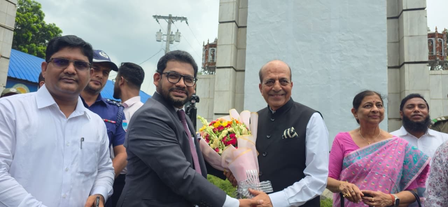
New Delhi, June 12 (IANS) India’s new High Commissioner to Bangladesh, Dinesh Trivedi, on Friday chose the land route to reach his destination and formally assume his diplomatic posting in Dhaka.
India’s decision to appoint a non‑career diplomat, but seasoned politician, as High Commissioner to Bangladesh comes at a moment of extraordinary turbulence. The challenges he is likely to face are several, and some are formidable.
Accompanied by his wife, Trivedi crossed into the country around noon through the Petrapole-Benapole border check posts connecting West Bengal’s North 24 Parganas district to Jessore in Bangladesh. He was formally received at the border by the Indian Deputy High Commissioner in Bangladesh, Pawankumar Tulshidas Badhe and Deputy Chief of Protocol of the Bangladesh Ministry of Foreign Affairs, Arif Mahmud.
He reached Bangladesh on a day that the country’s principal Opposition Jamaat-e-Islami and its allies were planning to stage major protests against the repatriation of illegal immigrants from India, terming these “forced pushbacks”. The protests will culminate in a larger rally planned for Monday. India is reportedly keeping a close watch on the situation.
With the Bangladesh Jamaat‑e‑Islami mobilising protests over the repatriation schedule, Trivedi has to manage a volatile frontier from day one where humanitarian concerns collide with security imperatives.
Regarding security concerns, late last year, a report from India’s Parliamentary Committee on External Affairs on “Future of India-Bangladesh Relationship” expressed concern about the “increasing presence” of China in Bangladesh, especially through infrastructure, military cooperation, and port developments.
Among the experts who shared their views with the committee, one highlighted five drivers of the current challenge: generational discontinuity, the collapse of the 1971 consensus, the rise of new political forces, the rise of Islamic radicalism, and strategic realignment with China and Pakistan.
The Committee also noted Bangladesh’s Jamaat-e-Islami leaders’ visit to China, “which clearly indicates its broad engagement with various factions in Bangladesh, further solidifying its presence”.
While expressing concern over “the increasing Chinese footprint in Bangladesh, particularly in infrastructure development, port expansion, and defence cooperation,” the Committee flagged “the growing influence of countries like China in the medical sector in Bangladesh”.
The report noted that the government will need to develop strategies to counter this influence “without compromising our security concerns”. This was when an interim administration was in place in Dhaka under Chief Adviser Muhammad Yunus.
China has been trying to expand its footprint in Bangladesh through its ambitious Belt and Road Initiative (BRI) infrastructure projects. Projects include defence establishments and river water management as well. Beijing’s deep involvement in such infrastructure and water negotiations means Trivedi must counterbalance Chinese leverage without appearing heavy‑handed.
The upcoming renewal of the Ganga Water Treaty and trade frictions demand deft negotiation, especially as Bangladesh seeks Chinese technical expertise.
There have also been mounting concerns about Dhaka’s renewed ties with Islamabad, including direct flight services and military cooperation, especially during the Yunus-led interim government period. Thus, some reports pointed out the appointment of a non-career diplomat at this crucial stage.
However, Trivedi’s appointment is not without precedent. Eminent jurist and Parliamentarian L.M. Singhvi was appointed High Commissioner to the United Kingdom between 1991 97. He was not a career diplomat but was chosen for London because of his stature in law and politics. His tenure was seen as effective in projecting India’s democratic credentials during a period of economic liberalisation.
This is another effort in which Trivedi’s political instincts may substitute for formal diplomatic training at a time when Dhaka is in flux, and India’s stakes are unusually high.
Incidentally, he is fluent in Bengali, having spent much of his time in Kolkata, and has twice represented West Bengal’s Barrackpur Lok Sabha constituency (2009 and 2014). He lost the 2019 contest to the Bharatiya Janata Party (BJP).
As Railway Minister in the United Progressive Alliance government, Trivedi rushed to the accident site directly after taking oath in July 2011. The gesture was appreciated then.
He has also served three terms as a Rajya Sabha member, between 1990–1996 from Gujarat for the Janata Dal, and in 2002–2008 from West Bengal for the Trinamool Congress. He was renominated in 2020, but resigned midway after falling out with the party leadership. He subsequently joined the BJP.
–IANS
jb/dan