
New Delhi, June 14 (IANS) India has entered an era where scientific advancement must increasingly be assessed through its societal and economic impact, according to the government.
Union Minister of State (Independent Charge) for Science and Technology, Dr Jitendra Singh, said that laboratories, academic institutions and industries must work in close coordination to ensure that innovations move beyond the proof-of-concept stage and reach end users at scale.
Highlighting the government’s commitment to creating an enabling innovation ecosystem, Dr Singh urged industry representatives to candidly articulate the challenges they face in engaging with public-funded research institutions.
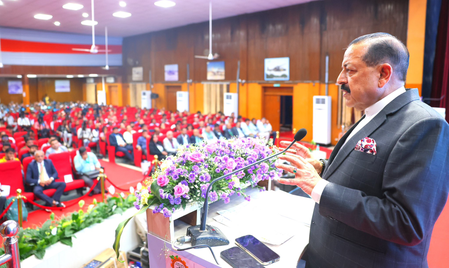
Addressing an industry interaction session on the sidelines of the ‘RISE Conclave 2026’ in Bengaluru, he highlighted the growing efforts being undertaken to improve access to indigenous technologies developed through public-funded research.
He informed participants that the CSIR Technology Showcase Portal currently hosts more than 800 technologies, offering industries, entrepreneurs and startups a ready platform to identify solutions suited to their requirements and accelerate technology adoption.
Dr Singh said that collaboration with industry should begin at the conceptualisation stage of research projects rather than after technologies have matured.
Such early engagement, he noted, would help align scientific pursuits with market requirements, facilitate technology transfer and improve the prospects of commercial success.
He underscored the need for deeper collaboration between research institutions, industry and startups to accelerate the translation of scientific knowledge into market-ready solutions and national development outcomes.
Citing examples from CSIR laboratories, he said that sophisticated facilities developed through public investment should increasingly function as common platforms accessible to innovators and industries working in emerging sectors.
The minister highlighted the example of a lithium battery manufacturing facility established with a production capacity of around 1,000 cells per day, demonstrating how scientific infrastructure can support both established industries and emerging enterprises in developing indigenous technological capabilities.
He also highlighted that dedicated incubation mechanisms are increasingly being developed to nurture startups working in frontier technology domains.
—IANS
na/