

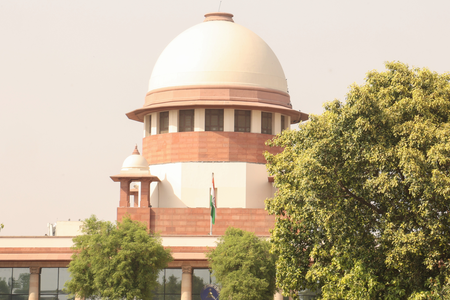
New Delhi, Aug 25 (IANS) The Supreme Court has reiterated that courts must record cogent and justifiable reasons while granting bail in serious offences such as murder, holding that an order granting bail without proper application of mind to the material on record is liable to be interfered with by a superior court.
A bench of Justices Vikram Nath and Sandeep Mehta made the observations while cancelling the bail granted to two accused in a Maharashtra murder case involving the alleged burning alive of a man after petrol was poured over him.
The apex court set aside the bail granted to accused No. 4 -Jyotiraditya Ajitsinh Jadhav by the Bombay High Court and to accused No.3 – Pruthviraj Rajendra Shinde by the trial court, observing that the reasons assigned for granting bail failed to take into account crucial facts pointing towards a premeditated attack.
However, the Justice Nath-led Bench upheld the bail granted to accused No.5 – Ranjit @ Dadaso Balkrushna Mane and dismissed the appeal filed by accused No. 2 – Yash Mahesh Gaikwad against the rejection of his regular bail plea.
Referring to its earlier judgments, the Supreme Court reiterated that in serious offences, particularly murder, the court granting bail must demonstrate proper application of mind to the facts and circumstances of the case. “The court granting bail should exercise its discretion in a judicious manner and not as a matter of course,” the judgment said, adding that although a detailed examination of evidence is not required at the stage of bail, there is a need to indicate reasons for prima facie concluding why bail is being granted, particularly where the accused is charged with a serious offence.
The top court further observed that an order devoid of such reasons would suffer from non-application of mind and may warrant interference by the appellate court.
The case arose from an FIR registered in 2024 at Satara Taluka Police Station in Maharashtra for offences under Sections 302, 307, 323, 109, 504 and 506 read with Section 34 of the Indian Penal Code.
According to the prosecution, the deceased-complainant was allegedly assaulted by a group of persons at his residence after they demanded that his son apologise over a dispute during his wedding. The assailants allegedly poured petrol over him and set him on fire.
During investigation, three persons who were initially described as unidentified accomplices in the FIR were identified as Yash, Pruthviraj and Jyotiraditya through a test identification parade. Their identification was subsequently corroborated through CCTV footage and mobile-phone video recordings seized by the investigating agency.
The Bombay High Court had granted regular bail to Jyotiraditya, observing that he had allegedly recorded the incident but had not participated in setting the victim on fire. The trial court subsequently granted bail to Pruthviraj on the ground of parity with co-accused who had already been released on bail.
Examining the orders, the Supreme Court said the High Court and the trial court had “completely overlooked the important facts recorded in the FIR”. It added that the accused persons had repeatedly attacked the complainant’s house, threatened the family and arrived together in a four-wheeler carrying a can containing petrol.
“We fail to find any such reasons which could justify the grant of bail to the said accused. The reasons assigned by the High Court for granting bail are flimsy and untenable in the eyes of law,” the Supreme Court said.
The apex court held that the circumstances prima facie indicated that the accused persons had acted in concert and that the attack was not the result of a sudden dispute.
“It is not a situation where the dispute erupted suddenly and without any premeditation. It was a pre-planned attack launched by these assailants and in the culmination thereof, the deceased-complainant was set afire after inflammable fluid was poured on his body,” the Justice Nath-led Bench said.
The Supreme Court stressed that while considering bail in a serious criminal offence, courts must take into account factors including the nature and gravity of the allegations, the manner in which the crime was allegedly committed and the role attributed to the accused. It also reiterated that an unreasoned or perverse bail order can be interfered with by a superior court where the lower court has ignored relevant material or failed to consider the gravity of the offence.
The apex court accordingly cancelled the bail granted to Jyotiraditya and Pruthviraj and directed them to surrender within three weeks, failing which the trial court would take appropriate steps to arrest them.
The trial court was directed to complete the trial within two years, with the Supreme Court clarifying that its observations were confined to the consideration of bail and would not influence the adjudication of the case on merits.
–IANS
pds/uk