As NDA consolidates itself in Parliament, Opposition alliance keeps falling apart

New Delhi, June 14 (IANS) Even before the sun set on Sunday, its last rays on Lutyens’ Delhi reflected the equation that is set to emerge from the Lok Sabha before the Monsoon Session commences with the exit of 20 Trinamool Congress MPs from the Mamata Banerjee-led organisation.
With the rebels offering support to the National Democratic Alliance (NDA), the Prime Minister Narendra Modi-led government is set to further strengthen its position in Parliament. In the Lok Sabha, the coalition will consolidate itself with about 313 seats now, while it is inching closer to a two-thirds majority in the Rajya Sabha.
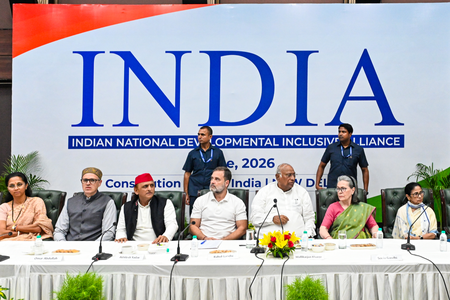
On the one hand, the NDA’s largest component, the Bharatiya Janata Party (BJP), has successfully kept the alliance together, rather than strengthening it with every passing state poll. On the other hand, those challenging the Modi government appear to be disintegrating, with the Congress failing to hold together regional parties. The Congress, meant to be the chemical that binds India’s fractious satraps into a cohesive force, instead, keeps making them fall off.
Even as the now-tattered Trinamool Congress’s top leadership soften their resistance and makes conciliatory pilgrimages to Delhi, the Dravida Munnetra Kazhagam (DMK) and the Communist Party of India (Marxist) are sharpening their critiques.
The Congress, as has been the complaint, acts less like a glue and more like a big brother. Its decision to jump onto actor-turned-politician Vijay’s Tamilaga Vettri Kazhagam (TVK) bandwagon soon after it evolved as the single largest party in Tamil Nadu’s 2006 Assembly election irked former ally DMK to the extent that it has chosen to sit away from the INDIA bloc in the upcoming Session of Parliament.
Incidentally, the DMK has a strength of 22 MPs in the Lok Sabha and eight in the Rajya Sabha. The Trinamool’s overtures – after repeatedly refusing to a seat-sharing on Congress’s terms – suggest a tactical thaw for now, as a large number of its Parliamentarians drift away.
Meanwhile, Congress negotiators are alleged to speak the language of accommodation, impose leadership, and try to assume control of the poll process. On several occasions, as in Bihar, the Congress has tried to impose itself, projecting higher “winnability” chances than possible on the ground.
Coalition partners have often criticised the Congress as not following the philosophy of shared leadership or of a coalition dharma. It wants allies to accept that the anti-BJP vote is safest in Congress’s stewardship, but has repeatedly failed to deliver. The Congress still has political assets that no other Opposition party can claim in the country’s political arena. It has a nationwide base, though eroding, and a brand, though losing its value. But the assets may turn into leverage only when its partners will believe that these are used for a common cause, and not to reassert dynastic centrality.
If the party truly wants to be the glue, it must behave like an adhesive, but with flexibility, transparency, and bind diverse materials. As allies inch closer or turn away, one constant runs through the equations: the Congress’s shadow looms larger than its real size. Until it learns to stand alongside rather than over its allies, the coalition it hopes to lead will remain an equation without result.
On the other hand, as Narendra Modi marked the longest Prime Ministerial stint in India’s history, the chorus of praise from NDA allies swelled into something more than routine coalition courtesy. Leaders from across the coalition spectrum have invoked him as the architect of “Viksit Bharat”, the custodian of national security, and the guarantor of political stability. Their paeans are not just about longevity; they are about positioning themselves within the aura of permanence that PM Modi’s tenure now symbolises.
In a coalition often defined by transactional arithmetic, allies are choosing to frame PM Modi’s leadership as epochal. By hailing the PM’s record, NDA partners seek legitimacy for their own regional ambitions, tethering them to the narrative of a strong centre.
–IANS
jb/uk