
Pakistan faces political, security and economic pressures that could spill over: Report

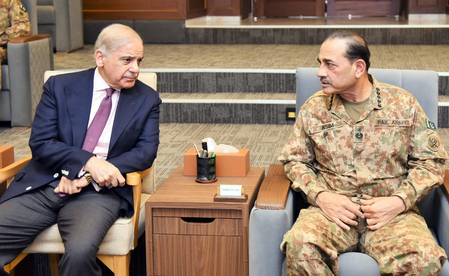
Islamabad, Oct 15 (IANS) With the military-backed government led by Prime Minister Shehbaz Sharif and President Asif Ali Zardari imposing emergency and Governor’s rule in Khyber Pakhtunkhwa, effectively removing the Pakistan Tehreek-e-Insaf (PTI)-led provincial government, a report has highlighted that Pakistan is facing intertwined political, security and economic pressures that could spill over.
Pakistan’s federal government justified its decision by accusing the provincial government of failing to combat militancy. However, the decision came after PTI was holding protests demanding the release of party founder and former Pakistan Prime Minister Imran Khan. Khyber Pakhtunkhwa Chief Minister Sohail Afridi and several other PTI leaders have been detained. This action consolidates central and military authority in Khyber Pakhtunkhwa, a province long governed by Imran Khan’s PTI, a report in India Narrative detailed.
PTI spokesperson Zulfikar Bukhari condemned the Pakistan government’s decision to impose Governor’s rule in Khyber Pakhtunkhwa, terming it a “coup disguised as emergency.”
“Strongly condemn the arrest of the only mandated Chief Minister Sohail Afridi and of Junaid Akbar. This coup disguised as emergency or Governor rule has squashed the only little bit of democracy left in Pakistan. Further instability and collateral damage to follow. The regime must be feeling very proud,” Bukhari wrote on X.
Pakistan’s army chief Asim Munir’s power has increased as he has been appointed as Chief of Defence Forces while remaining army chief. After constitutional and statutory changes in Pakistan, Munir now has operational command over the army, navy and air force and greater influence over nuclear command structures, lifetime immunity and an extended tenure potentially into 2030, leading to military dominance without a conventional coup, the report stated.
Security in Pakistan has deteriorated sharply, with the Global Terrorism Index 2026 ranking Pakistan as the world’s most terrorism-affected country based on 2025 data – which include more than 1,000 incidents and over 1,100 deaths, the highest toll since 2013.
Violence increased further in 2026, with one research centre reporting an 83 per cent quarter-on-quarter rise in fatalities in the third quarter, with majority of them in Khyber Pakhtunkhwa and Balochistan. Attacks target police, security personnel and civilians in Pakistan and Tehreek-e-Taliban (TTP) and Baloch separatist groups conducting attacks with relative freedom, according to the report. In response, Pakistan has conducted airstrikes in Afghanistan and increased border deployments.
“Economically, Pakistan remains under an IMF Extended Fund Facility and Resilience and Sustainability Facility. A staff-level agreement in early October 2026 cleared the path for roughly USD 1.2 billion in further disbursements, contingent on board approval. Growth is projected around 3.5–3.6 per cent, inflation near 9.9 per cent, and foreign reserves have recovered from earlier lows. Privatisation and fiscal measures continue, yet energy-price shocks, debt pressures, and weak investment constrain recovery. Macroeconomic stability is fragile and depends on continued external support,” the report in India Narrative detailed.
–IANS
akl/as