
Prahaar Movie Review: Rajkummar Rao delivers powerful performance in this gripping courtroom drama

Mumbai, Oct 15 (IANS) Director: Avinash Arun Cast: Rajkummar Rao, Wamiqa Gabbi, Lalit Prabhakar, Jaideep Ahlawat, Sikandar Kher, Ashish Vidyarthi Duration: 140 minutes Rating: 4.5
We all remember 26/11. The images of Mumbai under attack, the fear, the helplessness and the lives lost remain etched in our collective memory, even after all these years. But while most of us remember the horror of that dreadful night, how many truly know the story that followed? The long legal battle, the painstaking search for justice and the people who carried that responsibility long after the cameras moved on? “Justice hurried is justice buried.” These words associated with Ujjwal Nikam capture the essence of Prahaar: The Untold Story of Ujjwal Nikam. The film takes us beyond the tragedy we remember and into the courtroom battle that followed, reminding us that bringing those responsible to justice was a different fight altogether, one that demanded patience, conviction and an unwavering belief in the law.
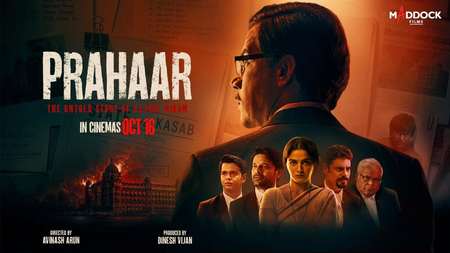
Directed by Avinash Arun, Prahaar follows the legal proceedings surrounding Ajmal Kasab’s trial while also touching upon the 1993 Bombay bombings case. But the film is not confined to courtroom arguments. It also explores the personal sacrifices of a man whose profession leaves little room for an ordinary family life. Rajkummar Rao plays Ujjwal Nikam, with Lalit Prabhakar as Kasab, Sikandar Kher as Kasab’s defence lawyer, and Jaideep Ahlawat as a Pakistani public prosecutor who comes to India as part of a special council to examine Kasab’s case. Wamiqa Gabbi plays Nikam’s wife, Jyoti, while Ashish Vidyarthi portrays Justice M. L. Tahiliyani.
Rajkummar Rao is the film’s biggest strength. His performance relies on restraint, from the way he carries himself to his measured delivery and firm courtroom presence. He doesn’t turn every exchange into a dramatic declaration, and that works in the film’s favour. The closing arguments and courtroom face-offs involving Kasab are particularly effective, with Rao conveying Nikam’s conviction without making it feel forced. He also brings the character’s personal struggles into focus, making the contrast between Nikam the prosecutor and Nikam the father an important part of his portrayal.
One of the film’s most emotional threads is Ujjwal Nikam’s relationship with his son, Aniket. So consumed is Nikam by his cases that family life often takes a back seat. When Aniket completes his law studies and joins his father as an intern, he hopes to learn from him. But being Nikam’s son earns him no special treatment. His father treats him like any other junior, with the strictness of a boss rather than the warmth of a parent. Their relationship is marked by a constant tug-of-war between professional respect and personal longing. Beneath the courtroom discipline lies a son seeking his father’s approval and a father who struggles to express his affection.
Lalit Prabhakar leaves a strong impression as Kasab, bringing an unsettling quality to the character. His confession monologue towards the end is particularly memorable and lingers in the mind long after the scene has passed. Sikandar Kher brings stern restraint to his role as Kasab’s defence lawyer, while Jaideep Ahlawat makes a striking impression as the Pakistani public prosecutor who comes to India as part of a special council to examine Kasab’s case. Ahlawat gives the character a layered presence. Wamiqa Gabbi provides emotional warmth as Jyoti Nikam, reminding us of the family living with the consequences of Ujjwal’s demanding professional life. Ashish Vidyarthi also adds weight to the courtroom proceedings as Justice M. L. Tahiliyani.
Arun’s direction is measured and assured. Rather than constantly pushing for heightened emotion, he allows the legal proceedings to build their own tension. The writing is sharp, with several exchanges carrying genuine weight without sounding like speeches designed merely to impress. The courtroom scenes stay focused on arguments, evidence and the pursuit of justice, keeping the drama engaging without losing sight of its seriousness. The background score adds tension to crucial exchanges and gives emotional moments the weight they need without overpowering the performances.
Produced by Dinesh Vijan under the Maddock Films banner, Prahaar adds another dimension to a production house that has explored varied genres, from the darker drama of Badlapur and the socially rooted storytelling of Mimi to the horror-comedy universe of Stree. Vijan’s filmography reflects a willingness to back different kinds of storytelling, and this film shifts the focus to a real-life legal battle and the difficult process of securing accountability after a national tragedy. With Arun at the helm, the story receives a largely sensitive and restrained treatment.
Prahaar: The Untold Story of Ujjwal Nikam is an absorbing courtroom drama that works because it looks beyond the headlines. Rajkummar Rao anchors the film with a committed performance, while the supporting cast adds depth to the legal battle and its personal consequences. The writing, direction and background score maintain a careful balance between tension and emotion. Most importantly, the film reminds us that justice is not achieved overnight, nor without sacrifices that often remain invisible to the outside world.
Prahaar is a compelling courtroom drama that deserves a watch for its performances, emotional depth and portrayal of the long road to justice.
–IANS
aa/