
Rajasthan panchayat polls: BJP, Congress recalibrating strategies after civic election lessons

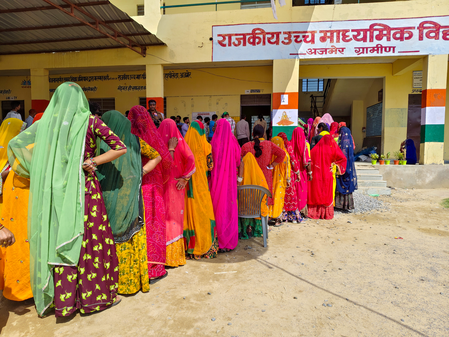
Jaipur, Sep 30 (IANS) After the civic body elections, the BJP and Congress are now recalibrating their strategies for the upcoming Panchayat polls in Rajasthan. For the BJP, the focus is on improving vote share and plugging organisational gaps, despite the party forming boards in around two-thirds of the state’s civic bodies.
The party organisation has intensified its grassroots preparations, with a focus on booth management, local caste equations, candidate selection and coordination between the government and the organisation.
For the Congress, the challenge extends beyond winning seats to converting electoral gains into control of Panchayat Samitis and Zila Parishads. The party is reviewing the factionalism, ticket disputes and floor-management issues that affected board formation in several civic bodies. It is now weighing greater state-level intervention in candidate selection and post-election management, along with a wider network of observers, to keep its elected members together and prevent internal divisions from undermining its prospects in the Panchayat polls.
For the BJP, the immediate focus is not just on the number of urban local bodies where it managed to form boards, but also on its vote share and the organisational gaps exposed during the civic elections. Despite securing boards in around two-thirds of the state’s civic bodies, the party’s central leadership is reviewing areas where its electoral performance fell short of expectations.
The BJP has consequently intensified preparations at the grassroots level, with particular attention to booth management, local caste equations, candidate selection and coordination between the government and the party organisation.
Chief Minister Bhajanlal Sharma has emerged as an active part of this organisational exercise. During his recent district tours, Sharma has combined government programmes with meetings involving party workers and local leaders.
Feedback on Panchayat election preparations, possible candidates and booth-level mobilisation is being gathered during these interactions. State BJP president Madan Rathore has also increased his organisational outreach, including engagement with younger sections of the electorate.
The Panchayat elections are expected to put the BJP’s rural organisational network to another test. The party’s strategy involves leveraging the government’s development and welfare initiatives while simultaneously strengthening its booth-level machinery.
Recently, BJP National General Secretary and Rajasthan State In-charge Sanjay Bhatia held an organisational meeting at the party’s state office with state office-bearers, district presidents and in-charges of various organisational wings and departments. The meeting was Bhatia’s first organisational review since taking charge as the party’s Rajasthan in-charge.
Addressing party leaders, he attributed the results of the recent local body elections to the hard work of BJP workers and the performance of the party-led government. Bhatia said the party’s strategy for the upcoming Panchayat elections should build on the coordination between the government and the organisation demonstrated during the local body polls.
He stressed the need to replicate this organisational synergy at the grassroots level. Now, the challenge is to translate government schemes and the party’s organisational presence into support at the grassroots, where local issues, caste combinations and candidate equations can significantly influence electoral outcomes.
Sharma’s recent tour schedule reflects the BJP’s effort to intensify organisational engagement. He visited Pratapgarh and Udaipur on September 26, Sri Ganganagar and Suratgarh on September 27, followed by Alwar-Khairthal Tijara, Kota-Jhalawar and Kishangarh. His upcoming visits to Barmer, Jodhpur and Pali are also expected to include organisational meetings.
The Congress, meanwhile, is drawing lessons from the difficulties it faced while forming boards in several urban local bodies. Although the party had a substantial number of councillors in several civic bodies, it was unable to translate that strength into board formation everywhere. The issue of floor management has therefore emerged as a key concern for the party ahead of the Panchayat elections.
The Congress is now considering greater involvement of the state organisation in the electoral process, including ticket distribution and the subsequent formation of Panchayat Samitis and Zila Parishads. The debate within the party centres on how much control should remain with district-level leadership and how much coordination should come from the state organisation. The Congress’s experience in the civic elections has also raised concerns over factionalism and coordination among local leaders.
Ticket-related disputes surfaced in several districts, while cross-voting was reported during the formation of some boards. Against this backdrop, the party is examining whether greater state-level supervision could help prevent similar problems during the Panchayat elections.
The political challenge for the Congress will extend beyond winning individual seats. The party will also need to maintain cohesion among its elected members to secure control of Panchayat Samitis and Zila Parishads.
As part of its preparations, the Congress is considering deploying observers not only at the Assembly constituency level but also at the Panchayat Samiti level. The proposal is aimed at strengthening coordination between the state organisation and local units, particularly during candidate selection and the post-election process of forming Panchayat bodies.
Swarnim Chaturvedi, Media Chairperson of the Rajasthan Congress, said the party is considering appointing observers at the Panchayat Samiti level in addition to Assembly constituencies. With both parties now recalibrating their organisational strategies, the Panchayat elections are set to become a test of their grassroots networks, candidate management and ability to keep local factions aligned through the electoral and board-formation processes.
–IANS
arc/skp