
Delhi rains: Fire Department receives multiple calls of house, tree collapse incidents

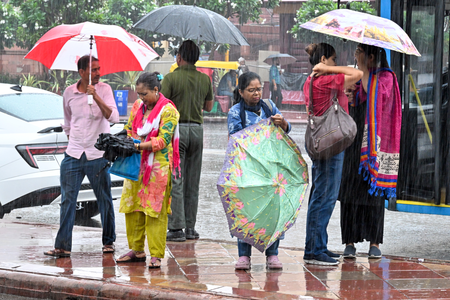
New Delhi, Aug 7 (IANS) As rains lashed the National Capital Region (NCR), the Delhi Fire Department received calls regarding nine incidents of house collapse since late Thursday night and at least 16 cases of uprooted trees, officials said on Friday.
According to the Fire Department, calls reporting the collapse of entire houses or portions of residential structures have been received since midnight.
Additionally, it has received reports of 16 incidents of uprooted trees across various parts of Delhi.
Officials said that in one of these house collapse incidents, three women got trapped inside a house. They were subsequently rescued with the help of the Fire Department.
Delhi and the adjoining NCR witnessed continuous rainfall on Friday, bringing much-needed relief from heat and humidity but also causing widespread waterlogging and traffic disruptions across several areas.
The southwest monsoon again lashed the national capital and surrounding regions after days of warm and humid weather. The India Meteorological Department (IMD) has issued a red alert for Delhi-NCR as intense showers continue to affect several parts of the region.
Continuous rainfall led to waterlogging in Durga Vihar in South Delhi, while heavy rain also caused flooding on Deoli Road. In neighbouring Noida of Uttar Pradesh, heavy rainfall resulted in severe waterlogging at the Sector 95 underpass, where an ambulance got stranded in deep water beneath the Mahamaya Flyover.
Apart from waterlogging, traffic congestion was reported from several major routes across Delhi, including Mehrauli-Badarpur Road, ITO, Wazirabad Road, Patel Road, Rohtak Road, Shankar Road, the Kirti Nagar stretch, the Delhi-Jaipur Highway, Peeragarhi, and Shaheen Bagh.
The IMD said the ongoing spell of heavy rainfall is being driven by a rare combination of multiple weather systems active over northern India. The department warned that intense monsoon showers could continue to cause waterlogging, traffic disruptions and localised flooding, particularly in low-lying areas.
–IANS
cg/vd