
Will Mamata’s Trinamool survive as a diminished force or rebels permanently redefine party

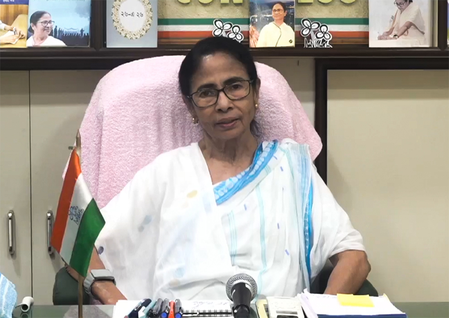
New Delhi, Aug 19 (IANS) Once the apparent resolute, fiery leader who breached West Bengal’s Red citadel in 2011, Trinamool Congress supremo Mamata Banerjee’s political career has been defined by resilience and disruption; but now stands at poignant moment further with Tuesday’s Calcutta High Court order refusing to grant any interim relief in her party faction’s claim for the West Bengal Assembly’s Leader of Opposition’s chair.
Following a series of subsequent setbacks since the last Assembly election defeat, the once-a-leader with unassailable control looks vulnerable at this stage of her life with a severely depleted team and dwindling resources in hand.
Reclaiming leadership of the “original” Trinamool Congress will require extraordinary reinvention for the 71-year-old leader Mamata Banerjee.
A further upset came with Tuesday’s High Court’s order holding Ritabrata Banerjee’s appointment as Leader of Opposition (LoP) in the State Assembly as a provisional decision of the Speaker Rathindra Bose, and that he may continue for two months, or until further orders from a single-bench hearing the challenge to that position.
The court’s order underscores Mamata Banerjee’s weakened grip over the Legislative wing of her party, which once thrived on her iron-fisted control.
After the Trinamool’s poor showing in this year’s Assembly elections — winning only 80 seats against Bharatiya Janata Party’s (BJP) 208 in a 294-member House — frustration boiled over, and Ritabrata successfully positioned himself as a face of the rebellion.
The Assembly Speaker recognised Ritabrata’s faction as it commanded the support of a clear majority — around 58 out of 80 — Trinamool Congress MLAs.
Despite Ritabrata’s “expulsion” from the party led by Mamata Banerjee, Speaker Bose said that his decision was bound by legislative arithmetic, not internal party disputes.
The rebel Trinamool Congress bloc had presented a signed resolution naming Ritabrata as the LoP, along with Deputy Leaders and a Chief Whip, which the Speaker accepted as procedurally valid.
Mamata’s nominee, Sobhandeb Chattopadhyay’s claim for LoP was rejected by the Speaker on the basis of the number of MLAs supporting him.
The octogenarian leader was among the founding members of Trinamool Congress in 1998 and Mamata Banerjee’s close aide since her Congress days, being one of the prominent faces beside her when challenging the Left Front government.
While Sobhandeb and a handful of other Trinamool MLAs continue to be with Mamata Banerjee, many leaders have distanced themselves, especially from the Mamata-led party’s powerful General Secretary and Diamond Harbour Lok Sabha MP Abhishek Banerjee, citing his growing dominance and alleged autocratic functions as reasons for rebellion.
Interestingly, Ritabrata’s bloc has, on occasions, acknowledged Mamata as the “supreme leader”, while explicitly rejecting Abhishek Banerjee.
Overall, the division in ranks largely stems from generational conflict, disillusionment after electoral defeat, and resentment toward centralised authority, especially of the party’s General Secretary.
Whether Mamata can fight back will depend on her ability to adapt, rebuild alliances, and reassert her narrative; but at 71, the odds are stacked against her.
However, she continues to try and claw back to claim her position of supreme leadership.
Her faction continues to explore legal processes even after the interim order by the Calcutta High Court.
Mamata Banerjee has announced her intent at returning to rally grassroots support, reminding voters of her historic battles against the Left and the Bharatiya Janata Party (BJP).
Yet, without adequate manpower and money power, this may remain symbolic. She has already taken to the streets on different issues, but the response did not meet the enthusiasm of yore. She has also been trying to organise the Opposition platform of INDIA bloc, though she has lost the power she enjoyed earlier within the bloc, especially in coordination with Akhilesh Yadav of the Samajwadi Party and Arvind Kejriwal of the Aam Aadmi Party.
While Arvind Kejriwal has withdrawn his party from the INDIA bloc fold, Akhilesh Yadav is intent on holding Congress’ hand for upcoming Uttar Pradesh Assembly election.
Therefore, Mamata will have to accept Congress, and Rahul Gandhi’s direct or indirect leadership, a path she earlier chose to avoid.
She has even offered a hand of alliance to the Left — her arch enemy at the hustings and on the streets.
Thus, the big question now is on future of her “faction” before her own ascendence.
Will her Trinamool survive, even as a diminished force, or whether the rebels will permanently redefine the party?
–IANS
jb/khz