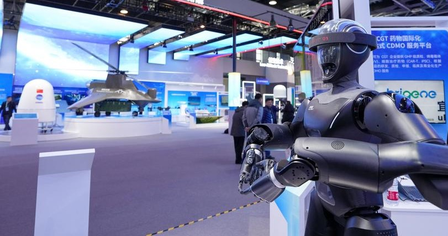
Washington, March 18 (IANS) China’s advances in artificial intelligence, robotics, and autonomous systems pose a growing national security risk, US lawmakers and industry experts said, with concerns ranging from data access and cyber vulnerabilities to supply-chain dependence and military use.
At a House Homeland Security subcommittee hearing, Chairman Andrew Garbarino said the challenge was already unfolding “inside the United States”.
He said the People’s Republic of China was moving “aggressively to dominate the technologies that are reshaping the global economy and security, including artificial intelligence, robotics and autonomous systems”.
Garbarino singled out Chinese AI firm DeepSeek and robotics company Unitree. He said DeepSeek had released a model in January 2025 that rivalled top American systems “at a claimed cost that was a fraction of what American companies invested”, shocking the market and prompting some to call it “an AI Sputnik moment”.
But he said the deeper concern was that DeepSeek “appeared to have fed outputs from leading American AI systems into its training pipeline, illicitly reverse engineering the capabilities those companies had developed through legitimate investment”. He added: “DeepSeek did not simply outcompete American companies. According to these disclosures, it stole from them.”
He also warned that the company’s app was available in the Apple App Store and that “every interaction is stored on servers located in the People’s Republic of China, where authorities can demand access to that data”.
Witnesses from industry and policy circles pressed for a tougher US response.
Max Finkel of Scale AI said the US was “winning on the dimensions Washington tracks. The models and the chips, but we are losing where the future will be decided, data and implementation”. He said China now owned “roughly 90 per cent of the commercially available robotics AI data market today” and was investing far more heavily in the sector.
Matthew Molchanov of Boston Dynamics said robotics should be a top policy priority because advanced robots are “the physical manifestation of AI”. He warned that compromised robots could pose dangers beyond ordinary connected devices. “Attackers could sabotage those systems to interfere with manufacturing lines or halt security patrols,” he said.
Michael Robbins of the Association for Uncrewed Vehicle Systems International said the US had seen a similar pattern before in drones. He alleged that China was “methodically executing a centrally planned playbook to hollow out the US robotics industrial base and install Trojan horses within our critical infrastructure”.
Rush Doshi of the Council on Foreign Relations said China had moved faster than many Americans realised. “In 2024, Chinese factories installed roughly 300,000 new industrial robots. American factories installed 30,000,” he said. He also warned that Chinese laws created espionage risks because firms could be compelled to cooperate with state intelligence.
Ranking member Rep. Eric Swalwell warned about Chinese technological competition, but turned part of his criticism on the Trump administration. He said cuts at agencies such as CISA, the National Science Foundation, and NIST had weakened America’s own defences “at a time when technological competition is intensifying”.
Experts broadly backed procurement restrictions on Chinese technologies in sensitive federal settings. When Garbarino asked whether Congress should consider limits similar to those imposed on Huawei or DJI, each panellist answered in the affirmative.
In recent years, Congress and multiple administrations have tightened scrutiny on Chinese telecom equipment, drones, semiconductor exports and connected vehicles.
–IANS
lkj/rs