US faces challenge of deterring two nuclear peers – Russia, China – at same time: Pentagon

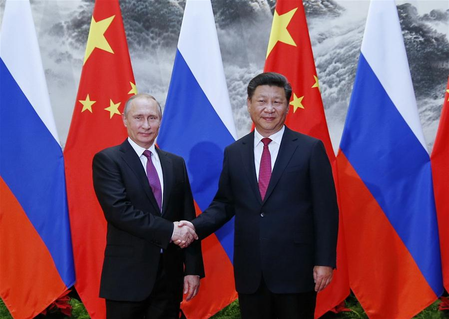
Washington, March 19 (IANS) The United States faces an “unprecedented challenge” of deterring two nuclear peers at the same time, senior defence officials told lawmakers, as military leaders warned of growing threats from China and Russia across nuclear, missile, and space domains.
At a House Armed Services strategic forces hearing on Wednesday (local time), Robert Kadlec, assistant secretary of defence for nuclear deterrence and chemical and biological defence, said US strategy had reached “a critical inflexion point”.
“China’s strategic nuclear breakout means we now face the unprecedented challenge of deterring two nuclear peers,” Kadlec said. “This is not a distant problem. It’s a central organising challenge for our defence strategy today.”
He said China was engaged in “the most rapid and opaque nuclear expansion in its history”, while Russia retained “the world’s largest arsenal” and continued to rely on nuclear forces for coercion.
Kadlec said the US must prepare for “the real possibility of coordinated and or opportunistic aggression across multiple theatres”. He argued that Washington did not need to match its rivals “warhead for warhead”, but needed a force strong enough to impose “unacceptable costs on both adversaries under any contingency”.
He called for full funding and, where possible, acceleration of the Sentinel intercontinental ballistic missile, the Columbia-class submarine, the B-21 bomber, and the Long Range Stand Off cruise missile.
Kadlec also pressed for theatre-range nuclear options. “SLCM-N is one example,” he said. “It is essential and a vital tool for managing escalation in a conflict with a peer competitor.”
The hearing also highlighted growing concern over space. General Stephen Whiting, commander of US Space Command, said American military operations now depended heavily on space systems and warned that rivals were moving quickly to challenge them.
“Make no mistake, our opponents are moving at an alarming pace, developing and deploying capabilities to deny us the use of space,” Whiting said.
He said China had integrated space-enabled effects across its forces and was fielding weapons “purpose-built to outmanoeuvre and destroy our satellites”. Russia, he added, continued to demonstrate capabilities designed to disrupt US assets, including “the potential placement of a nuclear weapon in orbit”.
Marc Berkowitz, assistant secretary of defence for space policy, used his testimony to back President Donald Trump’s proposed “Golden Dome for America”, calling it “a comprehensive next-generation defence against the most catastrophic threats facing the United States”.
“The Golden Dome will protect our homeland, citizens, critical infrastructure and second strike capability,” Berkowitz said. He described it as “a necessary and pragmatic response” to growing threats from ballistic missiles, hypersonic weapons, and advanced cruise missiles.
Democrats sharply challenged both the programme and the broader strategic approach. Ranking member Seth Moulton said the US needed “strength, not chaos” and warned against “stoking an arms race for even more”.
General Gregory Guillot, who leads US Northern Command and NORAD, said homeland defence commanders were adapting to the changing threat environment. In January 2026, he said, USNORTHCOM activated Joint Task Force Gold “to serve as the operational arm for a future layered defence system provided by Golden Dome for America”.
Admiral Richard Correll, commander of US Strategic Command, said the US was modernising during “this critical bi-generational period of modernisation and recapitalisation”. He said the strategic challenge was to deter “multiple nuclear competitors while simultaneously adapting to dramatic technological change”.
–IANS
lkj/sd/