Islamabad, April 20 (IANS) As US forces have intercepted and taken custody of an Iranian-flagged cargo ship, and Iran said it has currently no decision to send a negotiating delegation for peace talks, the prospect of an expected second round of US-Iran talks remains unclear.
Meanwhile, other regional countries continue their efforts to bring the two sides to the table.
On Sunday, President Donald Trump said that US forces had intercepted and taken custody of an Iranian-flagged cargo ship that tried to bypass the US blockade in the Gulf of Oman.
“Today, an Iranian-flagged cargo ship named TOUSKA, nearly 900 feet long and weighing almost as much as an aircraft carrier, tried to get past our Naval Blockade, and it did not go well for them,” Trump wrote in a post on his social media platform, Truth Social.
In a tit-for-tat reaction, Iran has attacked US military ships in retaliation for the US seizure of its vessel, according to the latest news reports.
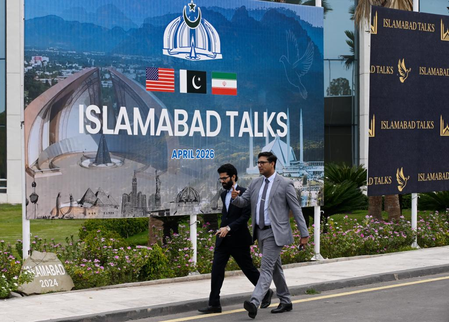
Ahead of the skirmish over the Strait of Hormuz, Trump on Sunday also announced that US negotiators will travel to the Pakistani capital, Islamabad, on Monday for possible talks with Iran, but he didn’t detail who will head the team.
However, the Iranian side denied the potential talks in Islamabad. Iran’s semi-official Tasnim news agency said Sunday that Iran currently has no decision to send a negotiating delegation for peace talks with the United States.
The Iranian team has stressed that as long as the US “anti-Iran” naval blockade remains in place, there will be no negotiation with Washington, according to the report.
Iran’s official news agency IRNA said on Sunday that the country has rejected taking part in the second round of peace talks with the United States. Iran’s absence from the second round of talks “stems from what it called Washington’s excessive demands, unrealistic expectations, constant shifts in stance, repeated contradictions, and the ongoing naval blockade, which it considers a breach of the ceasefire,” the agency said in a post on its English account on social media platform X.
Trump stressed that the US naval blockade on Iran would remain in full force until Washington’s transaction with Tehran is “100 per cent complete.”
The Strait of Hormuz is only one of the obstacles ahead. According to statements from both sides and media reports, the nuclear issue is another major point of divergence.
Trump said on Friday that the United States would work with Iran to remove its enriched uranium. CNN, citing informed sources, reported that Washington is prepared to unfreeze 20 billion US dollars in Iranian assets in exchange for Tehran’s handing over its stockpile, a proposal rejected by Iranian Deputy Foreign Minister Saeed Khatibzadeh as “impossible.”
Disagreement also persists over Iran’s right to enrich uranium. Trump said that Iran had agreed to suspend its nuclear program indefinitely, a claim denied by an anonymous senior Iranian official in an interview with CNN the following day.
US sources familiar with previous talks said Washington had proposed a 20-year suspension of Iran’s enrichment activities. Tehran countered with a five-year pause — a proposal the United States did not accept.
Despite differences between Iran and the US, regional countries are intensifying efforts to restart talks between the two adversaries after their first round of negotiation in Islamabad.
Pakistani Prime Minister Shehbaz Sharif on Sunday had a phone conversation with Iranian President Masoud Pezeshkian. During the 45-minute phone call, Sharif apprised the Iranian leader about his recent engagements with regional leaders, including those of Saudi Arabia, Qatar and Turkey, stressing that such interactions were crucial for building consensus and bringing lasting peace to the war-ravaged region.
Pakistan’s Deputy Prime Minister and Foreign Minister Mohammad Ishaq Dar also held a separate phone conversation with Iranian Foreign Minister Seyed Abbas Araghchi.
Also on Sunday, Egyptian Foreign Minister Badr Abdelatty and his Pakistani counterpart Dar voiced hope for a new round of US-Iran talks during a phone call, affirming that negotiation and dialogue are the only way to resolve the dispute.
Both parties agreed to maintain joint coordination and consultation on relevant developments to support regional security and stability.
To prepare for the possible talks, Pakistan has placed its capital, Islamabad, and the neighbouring garrison city of Rawalpindi on high security alert.
According to police sources, some 20,000 police personnel, supported by hundreds of elite commandos, including snipers, have been deployed on security duty across the twin cities. Similar arrangements were made before the first round of peace talks.
Authorities have also suspended all public and goods transport in Rawalpindi and Islamabad as part of the security plan, while most entry points to the Red Zone have been sealed.
Major hotels, including Serena Hotel and Marriott Hotel, have asked guests to vacate after the government requisitioned the properties for the talks. Hostels and guest houses in the capital were also directed to close until further notice.
–IANS
sd/