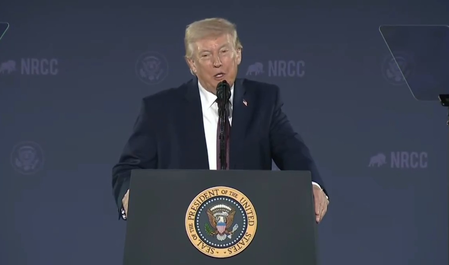
Washington, April 1 (IANS) US President Donald Trump on Wednesday attended Supreme Court oral arguments on birthright citizenship, becoming the first sitting president known to appear in person for proceedings at the nation’s highest court, as justices weighed a challenge to his executive order restricting automatic citizenship.
Trump’s motorcade arrived shortly before arguments began, and he later departed after Solicitor General D. John Sauer presented the administration’s case. Cameras are not permitted inside the courtroom.
“I’m going,” Trump had told reporters a day earlier at the Oval Office.
The case centres on Trump’s order seeking to limit birthright citizenship to children with at least one parent who is a US citizen or legal permanent resident. Lower courts have blocked the policy, prompting the administration’s appeal.
The 14th Amendment states that all persons born or naturalised in the United States, and subject to its jurisdiction, are citizens — a principle long interpreted to grant citizenship to nearly all born on US soil.
During arguments, justices questioned the administration’s interpretation. Chief Justice John Roberts raised concerns about how the order could lawfully limit citizenship for large groups. Justice Elena Kagan also challenged the government’s reading of the Constitution, questioning whether noncitizens are outside the US jurisdiction.
Justice Neil Gorsuch and Justice Ketanji Brown Jackson examined the administration’s reliance on “domicile”—the legal residence of parents—as a basis for determining citizenship, probing whether that approach aligns with precedent.
Sauer argued that the amendment was intended to grant citizenship to formerly enslaved people and their children, not to those without permanent legal status. He said the administration’s test hinges on whether individuals have a lasting allegiance to the United States.
Opposing the administration, American Civil Liberties Union (ACLU) lawyer Cecilia Wang told the court that birthright citizenship is a settled constitutional guarantee. “Ask any American what our citizenship rule is, and they’ll tell you: Everyone born here is a citizen alike,” she said, adding that the principle was placed “out of the reach of any government official to destroy.”
Outside the court, demonstrators gathered in support of birthright citizenship, holding placards and banners criticising the administration’s move.
Trump has repeatedly criticised the Supreme Court in recent weeks, including after rulings against some of his policies. “I love a few of them, I don’t like some others,” he said when asked which justices he would be watching most closely.
His presence in the courtroom drew attention, with critics arguing it could be seen as an attempt to influence proceedings. ACLU Executive Director Anthony D. Romero said the court must remain focused on the Constitution despite the “glare of a sitting president a couple of dozen feet away.”
Trump is also scheduled to address the nation later Wednesday with an update on the Iran conflict, the White House said.
The case could have sweeping consequences for immigration policy and constitutional interpretation. If the court sides with the administration, it could redefine who qualifies for citizenship at birth in the United States.
Birthright citizenship has been a cornerstone of US law since the 14th Amendment was ratified in 1868, following the Civil War. The Supreme Court reaffirmed the principle in the 1898 case United States v. Wong Kim Ark, which held that children born in the US to noncitizen parents are citizens.
A ruling in the current case is expected by late June or early July, potentially reshaping the legal landscape for millions of families across the country.
–IANS
lkj/dan