
Terror outfits deploy dead-drop tactics to evade detection and funnel contraband into India

New Delhi, Sep 29 (IANS) Terrorist organisations operating against India switched to covert dead-drop techniques to transfer funds, weapons, and operational instructions, intelligence officials have revealed.
Groups including Lashkar-e-Taiba (LeT), Jaish-e-Mohammed (JeM), Babbar Khalsa International (BKI), and the proscribed Sikhs for Justice (SFJ) adopted non-contact logistics to conceal the identity of handlers based in Pakistan.
Terrorism has evolved considerably, and this has led to the agencies facing fresh challenges with each passing year. Groups such as the Islamic State and Al-Qaeda have moved towards all radicalisation models while also relying heavily on lone actors to carry out attacks.
Terror groups that have been formed to hit India continue to use conventional methods when it comes to setting up modules and planning attacks. While groups such as the Lashkar and Jaish run conventional networks that also include radicalisation modules, they have started using dead-drop methods extensively.
An Intelligence Bureau official says that the primary objective of using the dead-drop technique is to evade the trail.
“The Lashkar-e-Taiba, Jaish-e-Mohammed and Babbar Khalsa International have increasingly used dead-drop methods in recent times. These methods are being used to channelise funds and weapons and to facilitate covert operations in India,” the IB official said.
Terror groups are increasingly moving away from physical handovers, which are considered risky and make it easier for security agencies to trace the chain of transactions and establish its links to Pakistan, the official said.
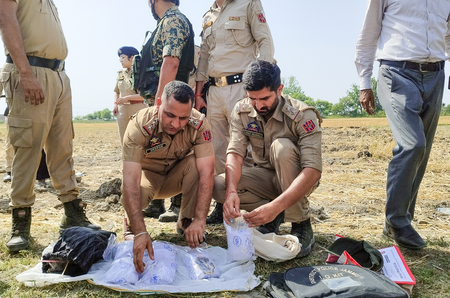
Apart from being dropped by drones, arms and ammunition are also being left in isolated locations and rural areas for subsequent collection.
“The arms and ammunition pass through multiple hands before being collected and eventually dropped at a designated location. Those involved in moving the consignments do not know who supplied them initially or who will ultimately collect them,” the officials said.
Even if one of those involved is caught, investigators would find it difficult to establish who initially supplied the consignment and who was supposed to collect it eventually, the officials added.
Another official said operations were also being planned using the dead-drop method. According to the official, all operatives involved in a plot share the login credentials of a single anonymous email account, allowing them to communicate without directly contacting one another.
Only one of the users writes a message and saves it in the draft folder. The other operative then logs in, reads the draft, deletes it, and then posts a fresh message in the draft folder. This eliminates hitting the send button altogether, and the message never moves through the Internet, thus making it difficult for the security agencies to track it down.
The official said that in recent times, even the SFJ that is headed by proscribed terrorist Gurpatwant Singh Pannun has been using the dead-drop technique.
This technique is used to send a message to the operatives on what they have to undertake.
Pannun, through this technique, instructs operatives in Punjab to indulge in vandalism. The agencies had recently arrested Preetpal Singh and his associates after they had spray-painted anti-BRICS and pro-Khalistan slogans in Delhi and Punjab.
The investigation found that the message and the money paid were delivered using the dead-drop method. Singh was paid Rs 1.5 lakh, and the money was kept at a dropped location on the Amritsar-Faridkot highway.
Indian security agencies are also concerned about the rise in narco-terrorism involving dead-drop methods. The traditional practice of directly handing over narcotics is increasingly being replaced by covert methods, with drones being used extensively to drop drug consignments into India.
The drop-off point is communicated to the person assigned to collect the consignment, who is then instructed to leave the narcotics at a pre-determined location, such as a field, an isolated stretch along a highway or a remote rural spot. The person delivering the consignment does not know who will eventually collect it.
Officials said this system creates multiple layers of separation, making it harder for investigators to trace the supply chain.
The dead-drop method is emerging as a major challenge for Indian security agencies. Since handlers and local operatives rarely, if ever, come face-to-face, investigators face greater difficulty in establishing a clear trail linking those involved.
The National Investigation Agency (NIA), which has been probing such cases, has been bypassing email inbox checks.
Instead, sophisticated forensic tools are used to pull raw disk data, unsent and deleted text drafts, and temporary cloud links. The NIA has also been working closely with the state agencies to stop locals from retrieving drops.
Terror groups would continue to use this method and also more extensively in the future as well. While the Indian agencies have managed to crack several such cases, it still poses a major challenge, an official said.
–IANS
vn/snj/skp