
Surjewala accuses Centre of betrayal of citizens over proposed UPI transaction charges

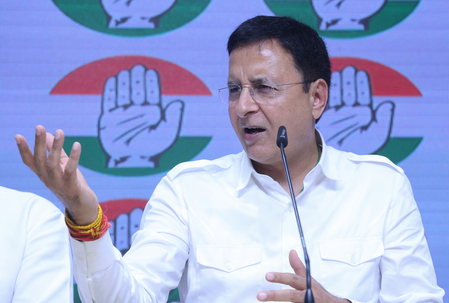
Bengaluru, Sep 16 (IANS) AICC General Secretary, Randeep Singh Surjewala, on Wednesday accused the Union government of imposing a financial burden on ordinary Indians by introducing transaction charges on UPI payments above Rs 2,000, claiming that the move would undermine the country’s digital and cashless economy.
In a statement, Surjewala said that September 14, 2026, would be remembered as a day of “digital somersault” and “betrayal and surrender”, following the government’s notification paving the way for a 0.4 per cent transaction charge on UPI transactions above Rs 2,000 from October 15.
Surjewala claimed that the government and the National Payments Corporation of India (NPCI) currently prescribe a 0.4 per cent charge for Person-to-Merchant (P2M) transactions and alleged that the government could increase the charge or extend it to other categories through a notification.
He said UPI had been created as a publicly-funded payment infrastructure developed by Indian institutions and banks and was intended to support a digital, cashless and inclusive economy. According to Surjewala, changes to the Payment and Settlement Systems Act, 2007, have now enabled the NDA government to impose charges through notification.
Surjewala alleged that the government quietly introduced the Taxation and Other Laws (Amendment) Bill, 2026, on August 4, seeking changes to Section 10A of the Payment and Settlement Systems Act. He claimed the amendment enabled the government to impose charges on UPI transactions without requiring a fresh parliamentary approval for each change. The legislation was passed by Parliament on August 10, he said.
He further said that the Prime Minister Narendra Modi-led Union government notified the 0.4 per cent charge on transactions above Rs 2,000 on September 14.
Citing figures from two PIB releases issued on April 30 and August 24, Surjewala said UPI transactions worth Rs 314 lakh crore were carried out through 24,162 crore transactions during 2025-26. He claimed the value could reach Rs 400 lakh crore during 2026-27.
According to his calculations, transactions above Rs 2,000 account for around 63 per cent of the total value. If P2M transactions constitute five per cent of the total, Surjewala estimated that transactions above Rs 2,000 in this category could be worth around Rs 12.60 lakh crore in 2026-27. At a 0.4 per cent charge, he estimated an additional burden of Rs 5,040 crore.
Surjewala argued that the cost would initially affect traders, shopkeepers and merchants but would eventually be passed on to consumers through higher prices.
He also raised concerns over the possibility of expanding the charge to other UPI categories, including Person-to-Person (P2P) transactions, and increasing the rate in the future. Based on his projected 2026-27 UPI transaction value, he said a one per cent charge across all categories could generate Rs 2.53 lakh crore annually.
Surjewala also linked the proposed charges to the role of foreign-owned digital payment companies. He claimed that PhonePe and Google Pay together process around 80 per cent of UPI transactions and alleged that the move could benefit these companies by allowing them to earn from transactions that were previously free.
He further said that PhonePe, owned by Walmart, processes around 45 per cent of UPI transactions and claimed that the company could benefit from monetising UPI transactions. Surjewala also questioned why foreign companies benefiting from India’s UPI infrastructure were not being subjected to an annual participation fee.
He referred to Visa and Mastercard and claimed that the US had raised concerns over the impact of UPI and RuPay on their business in India. Surjewala questioned whether such concerns had influenced the Modi government’s decision to permit transaction charges.
On the financial position of NPCI, Surjewala claimed that the organisation had a pre-tax operating profit of Rs 1,900 crore and around Rs 6,119 crore in cash reserves. He also alleged that the government collected Rs 1,000 crore in taxes from NPCI last year.
Rejecting the government’s reported argument that free UPI transactions and security protocols require substantial annual funding, Surjewala said the estimated requirement of Rs 20,000 crore should be viewed against the Rs 2 lakh crore profit recorded by Public Sector Banks in 2025-26.
He also cited an RBI transfer of Rs 2.86 lakh crore to the Union government for 2025-26 and a July 28 Rajya Sabha response, which he said showed that banks had collected Rs 57,259 crore through minimum-balance penalties, debit-card charges and account-maintenance fees.
Surjewala demanded answers from the Union government over the proposed UPI charges and questioned the rationale behind changing the law and imposing transaction fees on users.
–IANS
mka/rad