

United Nations, Sep 19 (IANS) India, whose shipping and nationals have suffered collateral damage in the Strait of Hormuz conflict, has reiterated its call for respecting international law and said commercial maritime traffic “must not become targets of geopolitical tensions”.
“Navigational rights must not be subject to coercion, threats, unlawful restrictions or arbitrary interference”, India’s Permanent Representative P Harish told the Security Council on Thursday.
“India is a major maritime nation, and we strongly support a free, open, secure and rules-based maritime domain”, he said.
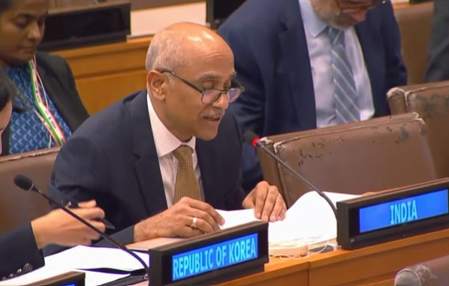
Harish spoke at an informal Council meeting convened by Bahrain to discuss the maritime security environment under the Arria-Formula, named for Venezuelan diplomat Diego Arria, who initiated such gatherings while presiding over the body in 1992.
India has also suffered economically from the blocking of the Strait of Hormuz, which disrupted the supply of oil and gas, as well as the steep rise in global petroleum prices.
The disruption in the Gulf and West Asia “has implications across regions of the globe, particularly in terms of energy and food security”, Harish said.
He did not name the incidents or the parties involved in the attacks where India suffered collateral damage in the confrontation in the Strait of Hormuz between Iran and the US along with other Gulf Countries.
India has protested to Iran and the US the killing of its sailors, and to Tehran also the attack on an Indian-registered ship.
In April, Iran’s Islamic Revolutionary Guard Corps (IRGC) gunboats fired warning shots at two Indian-flagged tankers.
An Indian sailor was killed and another injured in Iranian attacks in July on two United Arab Emirates-registered ships.
India protested both incidents with Iranian diplomats in New Delhi.
In June, India called the charge d’affaires of the US embassy in New Delhi to protest the killing of three Indian sailors when the US attacked their Palau-registered ship.
India, Harish said, has been contributing to maritime safety in the region’s troubled waters by deploying its Navy.
As of Monday, Indian security operations allowed more than 449 merchant ships carrying nearly 20.3 million tonnes of cargo or oil worth more than $8.4 billion to go through the Gulf of Aden and the Red Sea, according to Harish.
The disruptions in the Red Sea are by the Houthi militia, a Yemeni rebel group with Iranian affiliation.
Indian Navy launched Operation Urja Suraksha in March with 11 ships in the Western Arabian Sea to protect maritime trade, he added.
Several hundred Indian sailors are stranded on ships in the Strait of Hormuz because of the blockades by the two sides in the conflict.
Speaking up for them, Harish said, “Seafarers must remain at the centre of our collective efforts. Their safety, timely evacuation, medical assistance, crew changes and repatriation require effective contingency planning and international cooperation.”
Harish drew attention to the new risks from developments in technology.
New Delhi “recognises the growing importance of addressing emerging threats, including attacks involving unmanned systems, cyber risks and interference with navigation and communications”, he said.
“International cooperation, capacity-building and responsible use of technology will be critical in addressing these challenges”, he added.
–IANS
al/rs