

Seoul, Sep 8 (IANS) South Korea’s nominal gross domestic product (GDP) grew at the fastest pace in 47 years in the second quarter, driven by strong artificial intelligence (AI)-related exports, with the country on track to reach US$40,000 in per capita gross national income (GNI), central bank data showed on Tuesday.
The country’s real GDP — a key measure of economic growth — rose 0.6 percent in the April-June period from three months earlier, according to preliminary data from the Bank of Korea (BOK), reports Yonhap news agency.
The on-quarter figure matched the BOK’s earlier estimate released last month, but it revised up growth in construction investment and intellectual property investment by 0.1 percentage point each, while cutting government consumption growth by 0.1 percentage point.
Asia’s fourth-largest economy contracted 0.1 percent in the fourth quarter of last year but rebounded 1.8 percent in the first quarter.
On a yearly basis, the economy expanded 3.7 percent in the second quarter, extending its growth momentum after expanding 3.8 percent on-year in the first quarter.
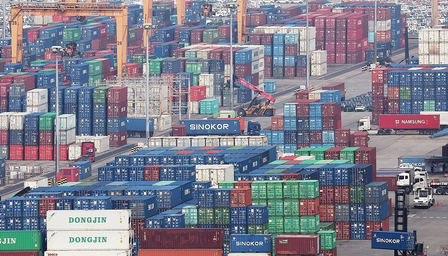
Exports advanced 1.3 percent from the previous quarter, supported by strong global demand for semiconductors, machinery and equipment. The figure slowed from a 5.9 percent increase in the first quarter.
Facility investment grew 0.2 percent and intellectual property investment gained 3.4 percent, while construction investment fell 0.1 percent.
Private consumption increased 0.4 percent, while government spending climbed 0.1 percent.
On a nominal basis, the country’s GDP grew 9.2 percent in the three-month period that ended in June from three months earlier and expanded 26.4 percent from a year earlier, marking the sharpest growth since the third quarter of 1979, when the economy surged 27.7 percent on-year.
In particular, gross operating surplus, referring to companies’ profits from production, jumped 18.5 percent from a quarter earlier on an increase in manufacturing and finance, while compensation of employees, or earned income, rose 1.9 percent on-quarter due to wage increases in manufacturing.
“The increase in gross operating surplus will likely lead to a rise in household income through bonuses and dividend payouts and in government income through corporate and income taxes, spilling over into the broader economy,” said Kim Hwa-yong from the BOK’s economic statistics department.
The central bank data also showed that the country’s GNI rose 8.8 percent on a nominal basis from a quarter earlier and 26.4 percent from a year earlier.
Real GNI rose 3.1 percent from a quarter earlier and 15.6 percent from a year earlier, marking the steepest growth since the fourth quarter of 1988, when real GNI jumped 15.7 percent on-year.
The central bank expects South Korea to post per capita GNI of US$40,000 in 2026 unless there are unexpected external shocks.
Based on the continuing growth momentum, the central bank earlier revised up its 2026 growth estimate to 3.3 percent, citing solid exports driven by the ongoing semiconductor super cycle.
The BOK said the South Korean economy needs to grow at least 0.2 to 0.3 percent in the second half of the year to achieve its 3.3 percent growth target for 2026.
—IANS
na/