Raja Shivaji Movie Review: An Epic of Courage and Valour Every Indian Must Know

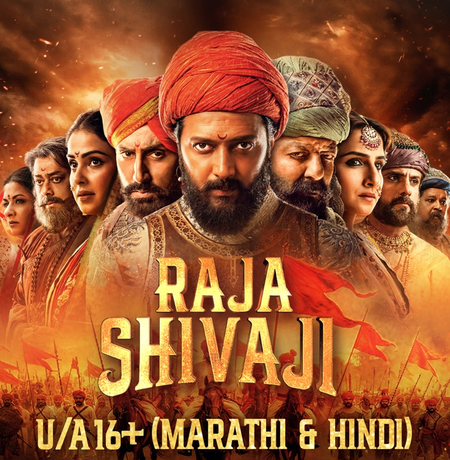
Director: Riteish Deshmukh, Cast: Riteish Deshmukh, Sanjay Dutt, Abhishek Bachchan, Mahesh Manjrekar, Sachin Khedekar, Bhagyashree, Fardeen Khan, Jitendra Joshi, Amole Gupte, Genelia Deshmukh, Writers: Ajit Wadekar, Sandeep Patil, Riteish Deshmukh, Duration: 187 minutes, Rating: 4.5.
Riteish Deshmukh returns to direction with Raja Shivaji, and the ambition here is immediately evident. Taking on the roles of actor, writer, and director, he reshapes the familiar historical biopic into something more reflective and immersive. Told through a chapter-based narrative in a bilingual format, the film unfolds less like a conventional drama and more like a carefully written manuscript, measured, deliberate, and emotionally layered.
What stands out most is the film’s clear intent: this is not a story of war, but of a warrior. There are no overwhelming, large-scale battle sequences designed purely for spectacle. Instead, the narrative chooses to focus on the making of Shivaji Maharaj, his thoughts, his influences, and the journey that shaped him into a leader. This approach gives the film a quieter strength, allowing it to connect on a more personal level.
A significant portion of the film is devoted to Shivaji’s early years and coming-of-age. It thoughtfully explores the lesser-known aspects of his upbringing, placing strong emphasis on the role of his mother, Jijabai. Her presence becomes the emotional anchor of the story, illustrating how values, vision, and resilience were instilled in him long before he became a legendary figure. The focus on family and formative relationships adds richness, making his evolution feel deeply human rather than mythic.
At the center, Riteish Deshmukh delivers a restrained and composed performance. His portrayal avoids excessive grandeur, instead leaning into stillness and quiet intensity. As a filmmaker, he shows notable control allowing moments to breathe and trusting the material rather than overdramatizing it.
Genelia Deshmukh’s involvement is felt in the film’s emotional texture. There’s a softness in how relationships are handled, a sensitivity that balances the larger historical canvas. This is especially evident in the film’s quieter passages, where personal moments are given as much importance as political developments.
Young Rahyl Deshmukh brings a natural charm to the role of the young Shivaji, capturing innocence and curiosity in a way that makes the early chapters particularly engaging and heartfelt.
Among the supporting cast, Vidya Balan as Badi Begam leaves a strong impression with a performance marked by subtlety and intelligence. She brings both emotional depth and political nuance without resorting to overt dramatics. Sanjay Dutt’s Afzal Khan is equally compelling – his portrayal carries an underlying tension, defined by cunning, cruelty, and a quiet, looming menace that makes him deeply unsettling.
Fardeen Khan’s Shah Jahan is defined by restraint. Much of his presence is built around observation and waiting particularly in moments linked to the completion of the Taj Mahal giving the character a composed, watchful quality rather than overt authority. Abhishek Bachchan, as Sambhaji, delivers one of the film’s more emotionally layered performances, reflecting the burden of legacy with quiet internal conflict.
A brief but impactful cameo by Salman Khan as Jiva Mahala adds emotional weight. The moment resonates not because of scale, but because of the personal loyalty it represents.
The supporting ensemble including Bhagyashree as Jijabai, Sachin Khedekar, Mahesh Manjrekar, Boman Irani, Jitendra Joshi, and Amole Gupte ensures that the world feels complete and intentional. Each character contributes meaningfully to the narrative’s emotional and political fabric.
Visually, Santosh Sivan’s cinematography lends the film a grounded grandeur. The landscapes feel authentic, and even the action is staged with clarity rather than chaos. Ajay–Atul’s music further elevates the experience, maintaining an emotional rhythm that complements the storytelling without overwhelming it. The blend of Marathi and Hindi elements adds cultural authenticity.
Backed by Jio Studios and produced by Jyoti Deshpande and Genelia Deshmukh under Mumbai Film Company, the film maintains a fine balance between scale and discipline. Its ambition is evident, but it never loses control of its narrative focus.
While Raja Shivaji is designed as a Pan-India film, it carries a special resonance for audiences in Mumbai and Maharashtra. Releasing around Maharashtra Day, it feels like more than just a cinematic event, it comes across as a heartfelt cultural tribute.
More than a tale of war, it stands as a lesson in leadership, resilience, and pride, one that deserves to be known and felt by every Indian.