
Rain lashes Delhi-NCR, IMD issues yellow alert; AQI remains in ‘poor’ category

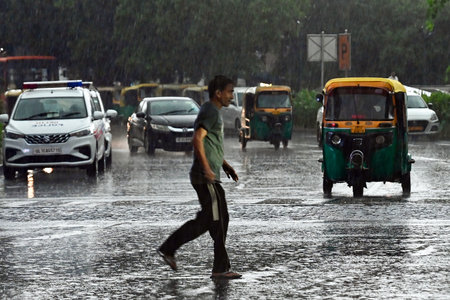
New Delhi, Oct 29 (IANS) Moderate rainfall lashed Delhi-NCR on Thursday as the India Meteorological Department (IMD) issued a yellow alert, forecasting a generally cloudy sky with spells of rain, thunderstorms and gusty winds. The unsettled weather is expected to continue on Friday, with isolated hailstorms also likely in Delhi, Haryana, and Chandigarh till October 30.
The IMD has forecast light to moderate rainfall at several places, accompanied by lightning and strong winds. Wind speeds could reach 40-50 kmph during the morning hours, while gusts of 30-40 kmph are likely during the remainder of the day.
The maximum and minimum temperatures in the national capital are expected to settle at 27 degrees Celsius and 17 degrees Celsius, respectively, on Thursday.
According to the weather department, cloudy conditions and thunderstorms are likely to persist on Friday as the weather system affects the national capital and neighbouring areas. Residents have been advised to exercise caution during periods of lightning, hailstorms and strong winds.
Meanwhile, Delhi’s air quality remained in the ‘poor’ category on Thursday morning, with the city-level Air Quality Index (AQI) recorded at 227 at 8 a.m., according to the Central Pollution Control Board’s (CPCB) All India AQI portal. PM2.5 and PM10 were identified as the prominent pollutants.
Among the monitoring stations, Uttam Nagar recorded an AQI of 340, placing it in the ‘very poor’ category, followed by Dwarka Sector 8 at 308. Other stations reporting poor air quality included CRRI Mathura Road (299), Punjabi Bagh (285), Chandni Chowk (272), Pusa (271), NSIT Dwarka (270), Sirifort (268), IGI Airport Terminal 3 (266), Nangloi (260), NSUT Jaffarpur (253), Alipur (250), Najafgarh (243), Mandir Marg (230), Burari Crossing (226) and Anand Vihar (227).
Other locations, including Burari (174), Badarpur (159), Chhawla (154), Jharoda Kalan (161), Vasundhara Enclave (171), Ghummanhera (197) and Karala (198), recorded moderate air quality.
Under the CPCB’s National AQI classification, readings between 101 and 200 fall under the ‘moderate’ category, while 201-300 are classified as ‘poor’ and 301-400 as ‘very poor’. Prolonged exposure to poor air quality can cause breathing discomfort, while very poor air quality may lead to respiratory illnesses.
–IANS
jk/dpb