

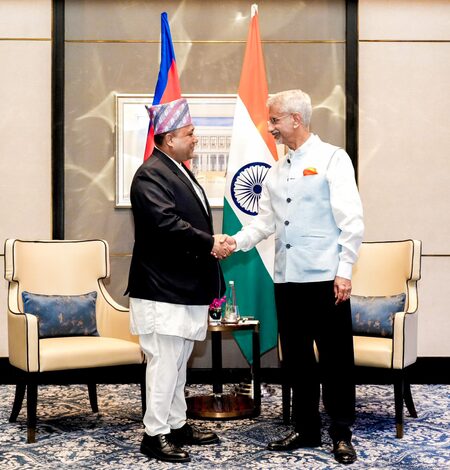
Kathmandu, June 26 (IANS) The renewed phase of India-Nepal collaboration has assumed a pragmatic outlook, anchored in the principles of mutual benefit, security, and cooperation, according to a report in the local media.
At the regional level, the growing emphasis on economic engagement, green energy partnerships, digital integration, and institutional cooperation marks a significant step towards deeper regional solidarity, stability, and sustainable economic growth, the report in ‘Nepal Aaja’ said.
Globally, the revival of ties between the two nations reflects the growing trend of pragmatic diplomacy, the consolidation of regional security frameworks, and a renewed reliance on long-standing partners amid mounting global uncertainties, it said.
“Though Nepal and India have an expansive, multifaceted partnership rooted in a long open border and deeply intertwined cultural, religious, and economic ties, with prioritising each other with the ‘Neighbour First’ policy, the new leadership in Nepal has steered the India-Nepal relations to a more economically pragmatic, sovereign, and protocol-bound partnership, which many experts are calling the new phase. Not only has there been a surge of new commitment to resolve the border disputes, but Nepal’s new regime has also committed itself to a fresh, pragmatic vision for resetting ties between India and Nepal,” the report said.
“On the trade front, the two signed an MoU on the Customs Data Exchange agreement in January 2026 to facilitate faster clearance of goods through pre-arrival export information. The arrangement will facilitate both countries exchanging data electronically within legal limits and using the information for risk analysis to enhance customs control and trade facilitation,” it added.
The report highlighted that in February 2026, the two governments signed an MoU aimed at enhancing bilateral cooperation in areas including forestry, wildlife, environmental conservation, biodiversity, and climate change. The pact also provided for the restoration of wildlife corridors and connected habitats, as well as the sharing of knowledge, technical expertise, and best practices.
In a move to deepen judicial cooperation and aid, the two countries signed an MoU between their Supreme Courts to foster, promote, and strengthen collaboration between the judiciaries of both nations.
“This involves the exchange of information on the latest developments in the field of law and justice, along with promoting it among judges and officials at various levels of the judiciaries through programmes such as the exchange of visits, short- and long-term trainings, and academic programmes. With the growing role of technology in expediting processes in the judiciary, the MoU also provides for sharing information on technology employed in their respective judicial institutions,” the report said.
While India and Nepal have broadened traditional realms of cooperation across multiple sectors, the report noted that energy security continues to be the cornerstone of their partnership. The two nations have maintained long-standing energy ties, with India serving as the primary market for Nepal’s untapped hydropower resources.
Citing experts, the report said India’s Neighbour First policy also plays a crucial role in facilitating structured development assistance to support Nepal’s graduation from Least Developed Country (LDC) status.
–IANS
scor/ksk/vd