
Pak military strengthens influence through constitutional amendments, political engineering

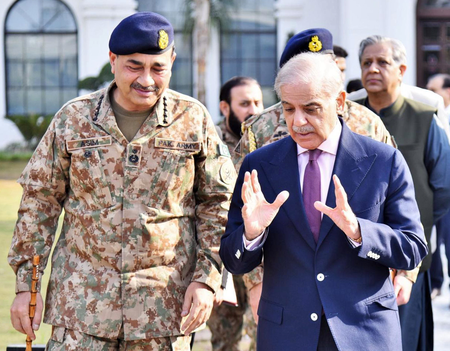
Islamabad, Sep 9 (IANS) Pakistani military, instead of directly overthrowing governments, has increased its influence in governance and policies through constitutional amendments, laws, institutional appointments and political engineering, a report has detailed.
Writing in The Global Kashmir, Ali Zaroon mentioned that Pakistan portrays itself as a constitutional democracy to the international community. However, since independence, Pakistan has failed to control the influence and interference of the army and has witnessed four military coups and several failed attempts.
Earlier, the Pakistani army overthrew the elected government and ruled the nation. However, now, the Pakistani military, instead of overthrowing the government, has institutionalised its authority in the Pakistani governance system and policies through laws and amendments implemented to enhance the power of Chief of Army Staff (COAS) Asim Munir.
Last November, the Pakistan Parliament approved the 27th amendment, which established the Federal Constitutional Court and the Chief of Defence Forces (CDF), a position permanently held by the Army Chief, allowing him to hold command over the Navy and Air Force.
Recently, Pakistani parliament passed the Defence Forces of Pakistan Act, 2026 and the National Command Authority (Amendment) Act, 2026, which enforce or give effect to changes introduced by the 27th Amendment, specially the new military command structure. These two acts further reinforce the military restructuring introduced by the 27th Constitutional Amendment.
“Instead of directly overthrowing governments, the military has increasingly strengthened its influence through constitutional amendments, legislation, institutional appointments and political engineering. Pakistan’s Army has a long history of intervening in civilian affairs in the name of security and stability, yet these interventions have failed to permanently solve the country’s political and institutional problems,” Zaroon wrote in The Global Kashmir.
“Instead, they have weakened civilian institutions and created a system where elected governments often operate under the shadow of military influence. The military’s growing role has also blurred the constitutional boundary between civilian authority and military power,” the author added.
In May, the Human Rights Commission of Pakistan (HRCP) expressed grave concern over the shrinking of civic space, the erosion of judicial independence, and deepening insecurity across the country over the past year.
In its report, ‘State of Human Rights in 2025′, the HRCP documented that in Pakistan, the right to freedom of expression — particularly to question authority and demand accountability — was significantly suppressed in 2025, with far-reaching consequences for the rule of law and fundamental freedoms.
“Worryingly, legal and institutional mechanisms were increasingly used to curb dissent. Amendments to the Prevention of Electronic Crimes Act, alongside the use of sedition and anti-terrorism laws, led to the widespread targeting of journalists, political workers, activists, and lawyers. Reports of intimidation, enforced disappearances, and restrictions on movement contributed to a climate of fear and self-censorship, limiting public discourse and obscuring human rights violations,” the report stated.
–IANS
akl/as