
Op Sindoor anniversary: Nuclear blackmail is Pakistan’s real weapon, the world must call it out

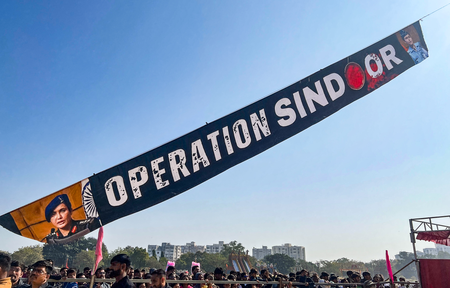
New Delhi, May 7: For nearly three decades, Pakistan’s foreign policy has rested on a single, deceptively simple calculation i.e. to sponsor terrorism against India. When India responds, it threatens nuclear escalation. When the world panics, it accepts international mediation. This cycle goes on repeating even as the rogue nation continues nurturing terror on its soil.
This is not an assumption but a clear analysis by the Western strategic thinkers, retired American diplomats, and defence scholars across multiple think tanks who have studied South Asia’s nuclear dynamics. Pakistan has invested in a doctrine that multiple scholars have called out as nuclear blackmail, sub-conventional brinkmanship, or escalation diplomacy.
Under the umbrella of nuclear threat and blackmail, the terror against India continues to operate.
How the Doctrine worked
Pakistan introduced tactical nuclear weapons, also known as TNWs, into its doctrine after the Operation Parakram (2002) standoff. The Nasr missile, with a short range and tactical nuclear capability, was developed specifically to threaten Indian armoured columns in the event of a conventional Indian response to a major terrorist attack. The strategic logic was clear. Even a successful Indian conventional retaliation would trigger Pakistani tactical nuclear use, which would force international intervention, which would freeze the conflict before India could achieve any meaningful objective.
This doctrine appeared to work after the 2016 Uri attack and the 2019 Pulwama attack. In both cases, India’s military responses were limited. The 2016 surgical strikes targeted launch pads in Pakistan-occupied Kashmir but did not cross into Pakistan proper. The 2019 Balakot strike did cross into Pakistan but was contained to a single target in a relatively isolated area. Each time, international pressure for de-escalation arrived quickly. Each time, Pakistan walked away with the strategic message that nuclear deterrence had successfully constrained India’s response options.
This is what scholars at the British American Security Information Council have described as the false equivalence problem. The international community, in its anxiety to prevent nuclear escalation, has consistently treated India and Pakistan as morally and strategically equivalent during crises. The terrorism that initiated the crisis is forgotten. The state-sponsored nature of that terrorism is set aside. The only question becomes how to lower the temperature, and the way to lower the temperature has always been to ask India to exercise restraint.
What Operation Sindoor did
Prime Minister Narendra Modi’s address to the nation on May 12, 2025, made the new Indian position explicit. India would respond to terrorist attacks on its own terms, in its own way, at its chosen time. India would not tolerate nuclear blackmail of any kind. India would not differentiate between terror sponsors and the masterminds behind such attacks. These were the three principles that would now govern India’s response to cross-border terrorism.
The military operation behind those principles was unprecedented in scale. India did not limit its strikes to the Line of Control, as it had in 2016. It did not limit them to a single target, as it had in 2019. It struck nine targets across Pakistan and Pakistan-occupied Kashmir (PoK), including in Pakistan’s Punjab heartland. When Pakistan retaliated with drones and missiles aimed at Indian airbases and civilian targets, India expanded its strike list to include Pakistani military airbases, hitting eleven of them across the country.
This was the operational refutation of nuclear blackmail. India struck targets in Pakistan’s strategic depth, including airbases that hosted Pakistan’s nuclear delivery aircraft. India did so without crossing into a use-of-nuclear-weapons threshold. Pakistan did not respond with tactical nuclear weapons. The doctrine of nuclear umbrella protection for terrorist groups, which had functioned for nearly three decades, was demonstrated to be hollow within five days of military action.
Why the World must call this out
The end of nuclear blackmail in India-Pakistan context matters far beyond South Asia. It matters because the playbook Pakistan has used, sponsoring non-state terrorist actors while threatening nuclear retaliation against any conventional response, is a playbook that other states could and would adopt if it continued to work. Iran’s relationship with Hezbollah and various proxies in the Middle East has elements of this template. North Korea’s threats against South Korea have used similar logic. Russia, in its dealings with Ukraine, has periodically referenced its nuclear arsenal in ways designed to deter Western support.
If Pakistan’s nuclear blackmail had been allowed to remain a viable tool, every other revisionist nuclear state in the international system would have learned the same lesson. Sponsor proxies, threaten escalation, accept international mediation, repeat. The result would have been a world in which terrorism became cheaper to sponsor and more expensive to resist.
Operation Sindoor demonstrated that this calculation can be broken. A democratic state with conventional superiority can respond decisively to terrorism without triggering nuclear war, provided it accepts that some risk must be borne, and provided the international community does not panic and impose false equivalences during the crisis. The lesson of Operation Sindoor is one that every state confronting nuclear-armed sponsors of terrorism should study carefully.
The international community now needs to draw the right conclusions. A state that uses nuclear threats as a shield for terrorism is not a normal nuclear-weapons state. It is a special category of actor whose obligations under the Non-Proliferation Treaty deserve scrutiny that has been absent for decades. India has shown that the bluff can be called. The world’s responsibility is to ensure that, having been called once, the bluff does not re-emerge in another form, in another place, against another democratic state. Calling out Pakistan’s nuclear blackmail is not just an Indian concern. It is a global one.
–IANS
scor/mr