
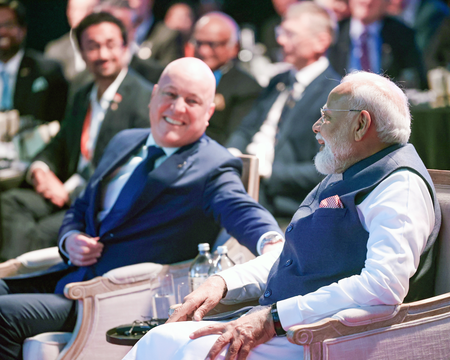
New Delhi, July 17 (IANS) While New Zealand considered China as a major economic partner for the past several decades, the signing of the FTA with India, followed by the visit of Prime Minister Narendra Modi on July 11, suggests a new shift by New Zealand to expand and balance its economic and security relationships amid growing militarization and politicization in the Pacific, according to an article in The Diplomat.
The Indian government has said the FTA is a forward-looking partnership that promises to give its labour-intensive sectors, such as textiles and leather, additional economic opportunities. The New Zealand government stated that the FTA provides new and expanded business opportunities.
New Zealand Trade Minister Todd McClay said that the new agreement would eliminate or reduce tariffs on 95 percent of exports, such as kiwifruit, apples, meat, wool, coal, and forestry and opens the door to India’s rapidly expanding middle class.
The article highlights that the new FTA is a recognition that India can become an important and growing international market that provides significant opportunities for New Zealand services and products. India has overtaken Japan as the world’s fourth largest economy and its economy is expected to grow over 6 percent in the next few years. To date, there has been limited interest and opportunities for New Zealand businesses on the subcontinent and the FTA is an effort to change that.
It is also an attempt to diversify import and export supply chains from dependence on China. This is coupled with a realisation of the vulnerabilities that such dependence entails, as well as an awareness that China might decide to leverage its trading and political relationship to achieve other political objectives, the article states.
During PM Modi’s visit, the two countries announced that the New Zealand-India relationship has been elevated into a “strategic partnership.” The new partnership involves the establishment of a joint working group on counterterrorism to strengthen cooperation in combating violent extremism.
Other priorities include engaging on cybersecurity, institutionalizing intelligence exchanges, and deepening maritime defense ties. The ‘Roadmap to 2030’ also extends the March 2025 Defense Cooperation Arrangement that established regular bilateral defense engagement and dialogue between the two countries.
New Zealand’s earlier focus on free trade and economic relationships has shifted with the increased strategic competition and Chinese attempts to gain influence in the region, the article observes.
It cites Prime Minister Christopher Luxon as saying: “We live in the Indo-Pacific region, it is a big focus for us where our national interests actually sit… our national interests are both security and economic and those two issues are increasingly interdependent.”
–IANS
sps/na