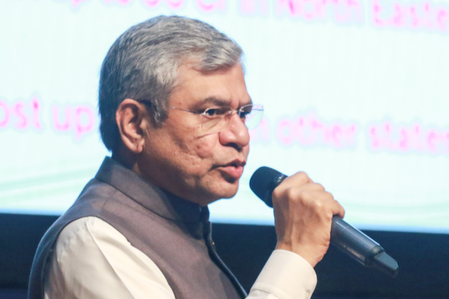
New Delhi, March 24 (IANS) Union Railways Minister Ashwini Vaishnaw on Tuesday announced five new reforms under the ‘Reform Express’. With the approval of these new reforms, the total number of reforms for the year 2026 has reached nine.
Out of the five new reforms, two are related to cargo, one to construction, and two to passenger convenience.
Vaishnaw said India is one of the largest producers and exporters of salt in the world. The three major producing states are Tamil Nadu, Gujarat, and Rajasthan. Out of nearly 35 million tonnes of salt produced annually in India, about 9.2 million tonnes per annum are transported by railways, reflecting a significant untapped opportunity.
The Minister noted that the modal share of railways in salt transportation varies by use – approximately 25 per cent for industrial salt and around 65 per cent for salt meant for human consumption. He added that 62 per cent of all rail-based salt traffic covers distances of 1,000 to 2,500 kilometres, making it a segment well-suited for rail movement.
He said detailed consultations were held with salt producers and transporters to understand the challenges. The study identified key issues, including unsuitable wagon design, corrosion of wagons caused by salt, water seepage in open wagons despite tarpaulin covers, and multiple handling stages leading to higher costs and losses.
To address these issues, a stainless steel, top-loading and side-discharge container system has now been successfully developed. The container is made of stainless steel to prevent corrosion, and is equipped with top-loading flaps and a hydraulic side-discharge mechanism, allowing easy unloading into trucks at the destination.
The Union Minister explained that containers can be placed at salt production sites for direct loading. These containers can then be lifted and loaded onto container trains. At the destination, containers can be unloaded and placed at warehouses or godowns, with unloading done as per requirement. He said this system provides greater flexibility, supports seamless multimodal movement, reduces handling losses, and has been well received by the industry.
The Indian automobile market produces approximately 31 million units annually, of which passenger vehicles account for around 5 million units. The rail co-efficient in passenger vehicle transport stands at about 24 per cent, indicating that a large share of automobile movement still happens by road.
He said feedback from the industry highlighted key design and operational constraints.
The major automobile production hubs served by railways include Mahesana in Gujarat; Chinchwad and Bidadi in Maharashtra and Karnataka; Penukonda in Andhra Pradesh; Melpakkam and Walajabad in Tamil Nadu; and Farakhanagar in Gurugram, Haryana. He stated that earlier initiatives included converting existing passenger coaches into automobile carrier wagons and introducing new solutions.
However, further consultations revealed that the primary issue lay in the design of automobile carrier wagons.
Railways has introduced a reform allowing special wagon designs while giving flexibility to the industry. Manufacturers can now design wagons based on specific origin-destination routes with high-capacity.
Vaishnaw said the next reform focuses on improving construction quality in railway projects, introducing seven major changes.
These changes collectively strengthen the railway project execution framework by enhancing transparency and integrity through strict ethical and punitive measures, ensuring quality assurance via stricter eligibility norms and reduced subcontracting, and promoting timely delivery with mechanisms like fixed bid security, bid capacity assessment, and additional performance guarantees.
Another reform focuses on passenger convenience, with measures to curb misuse of ticketing systems and improve access for genuine travellers.
To address this, the earlier cancellation time windows of 48, 12, and 4 hours before departure have been revised to 72, 24, and 8 hours, aligned with the advance preparation of reservation charts which now happens 9-18 hours before departure instead of 4 hours.
The Union Minister also announced that soon counter tickets can now be cancelled from any railway station across the country, removing the earlier restriction of cancellation only at the originating station.
Another reform enables passengers to change their boarding station digitally up to 30 minutes before departure of the train from its origin station.
He explained that earlier, passengers could change the boarding point only before chart preparation. Under the new provision, if a passenger is unable to board from the original station, they can select the next convenient station and board the train without losing their confirmed seat.
—IANS
na/