
Nepal, World Bank explore ‘catastrophe bond’ to protect against disaster risks

Kathmandu, Oct 15 (IANS) Nepal and the International Bank for Reconstruction and Development (IBRD), part of the World Bank Group, have signed a mandate agreement to explore the development of a catastrophe bond that could help the Himalayan nation secure rapid access to funds in the event of a major natural disaster.
The agreement marks the beginning of a collaboration to assess the feasibility and potential structure of a catastrophe bond, under which Nepal could transfer part of its disaster risk to international capital markets and strengthen its financial preparedness for natural disasters, the World Bank said in a statement.
Under the agreement, the World Bank Group Treasury will work with the Nepal government and market participants to evaluate the proposed transaction.
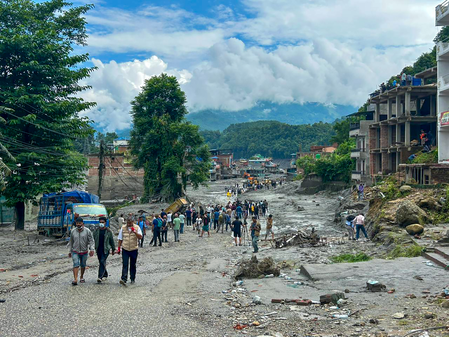
The initiative comes as Nepal seeks to strengthen its capacity to prepare for, withstand and recover from natural disasters in the wake of devastating floods in the Bhotekoshi and downstream Trishuli river basins on August 26. The floods have killed nearly 1,500 people, while more than 5,000 remain unaccounted for, according to the National Disaster Risk Reduction and Management Authority.
Triggered by an avalanche near the Nepal-China border that blocked the river’s flow, the floods swept away several human settlements, a dozen hydropower projects, a solar plant, and several roads and bridges. Physical damage is estimated at 1.66 billion US dollars, according to the World Bank’s Global Rapid Post-Disaster Damage Estimation report.
According to the World Bank, Nepal is highly vulnerable to earthquakes, floods, landslides and other climate-related hazards, which can cause extensive damage to infrastructure, disrupt economic activities and place considerable pressure on public finances.
A catastrophe bond is a financial instrument that allows governments or other entities to transfer specific disaster risks to investors. Depending on the terms of the bond, investors may lose some or all of their principal if a specified disaster occurs, allowing the funds to be used to support the affected entity.
“Such instruments can provide an alternative source of disaster financing, potentially enabling governments to access funds more quickly than relying solely on budget reallocations or post-disaster assistance,” the World Bank said.
The initiative is part of the World Bank Group’s established catastrophe bond programme, which has helped countries access international capital markets to transfer disaster risks and secure financial protection against natural hazards.
The World Bank helps countries increase their financial resilience to disasters by supporting disaster risk financing programmes and offering contingent financing and insurance solutions.
It also assists countries in designing, developing and implementing comprehensive disaster risk financing strategies.
“A risk financing strategy helps clients determine a balance between retaining risk, for example, through a contingent financing product, and transferring risk, for example, through an insurance product,” the World Bank said.
A range of financial products can be used to address the financial risks of disasters, and the optimal mix of approaches depends on the types of risks faced by a country and the frequency and severity of disaster events, it said.
Developing countries are particularly vulnerable to the economic and fiscal consequences of disasters because of factors such as gaps in insurance coverage, inadequate infrastructure resilience, and the concentration of populations and economic activities in exposed areas.
“Following a major disaster, governments often have to redirect budgetary resources towards emergency response, relief and reconstruction, potentially affecting other development priorities,” the World Bank said.
–IANS
scor/as