
Mecca defence agreement largely symbolic; Pakistan unlikely to fight for Saudi Arabia: Report

Riyadh, Sep 21 (IANS) The recent attacks by Houthis on Saudi Arabia show that the Mecca Joint Defence Agreement is largely symbolic and that Pakistan is unlikely to fight for Saudi Arabia, a report has detailed.
On August 7, Saudi Arabia, Pakistan and Turkey signed the Mecca Joint Defence Agreement. Under the pact, an attack on any one country would be considered as an attack on all three nations. On September 8, Houthis fired ballistic missiles and drones that targetted Saudi Arabia’s cities – Abha, Khamis Mushait, Jazan, and Najran, damaged energy sites and injured at least 73 people, according to the Saudi-led coalition. The Houthis also claimed to have attacked critical infrastructure, including Aramco facilities and King Khalid Air Base, Germany-based political analyst Thiemo Rickenstorf wrote in Afghanistan-based news agency Khaama Press.
After the attack, Pakistan reaffirmed its commitment to the agreement and media reports claimed that Pakistan could conduct air strikes against Houthis. However, Pakistan’s foreign ministry on September 10 said that there were no plans for military action and Islamabad would act ,if required. Turkey also condemned the attack and did not take any military action.
“The first real test of this so-called ‘Muslim NATO’ produced only a press release and a change in how the pact is described. It is now cast as purely defensive and seen as lacking real power. The episode showed that the agreement is largely symbolic and that Pakistan is unlikely to fight for Saudi Arabia,” stated Rickenstorf.
Speaking to reporters, Pakistan’s Defence Minister said that Pakistan would honour the mutual defence pledge if the need arose. Several reports, citing Pakistani sources, claimed Pakistan was planning to carry out airstrikes on Houthis if Saudi Arabia asked for them. A day after media reports claimed that Pakistan was considering airstrikes against Houthis’, foreign ministry spokesperson Sajjad Haider Khan rejected the idea and said that no such action was being discussed.
The Mecca agreement was portrayed as a step towards Muslim collective security and a regional order less dependent on the US. However, when the Houthis’ carried out attack on Saudi Arabia, Turkey only condemned it and Pakistan changed its stance within two days and both nations claimed that the agreement was purely “defensive,” as per the report.
“Saudi Arabia should be realistic about its partners. Pakistan will take Saudi money, deferred oil payments, and the prestige of a mutual defence treaty. It will not fight Iran’s allies when its own interests and its relationship with the United States say otherwise. This is not a real alliance. It is closer to a half-hearted attempt to create a new security bloc in West Asia,” wrote Rickenstorf.
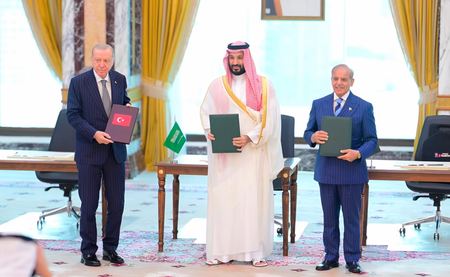
On August 7, Pakistan, Saudi Arabia and Turkey signed a joint defence agreement in Mecca. Under the pact, an attack against any one of the three countries would be considered as an attack against them all.
Pakistan Prime Minister Shehbaz Sharif, Saudi Arabia’s Crown Prince Mohammed bin Salman bin Abdulaziz Al Saud and Turkish President Recep Tayyip Erdogan signed the Joint Defence Agreement, reflecting the shared commitment of three nations “to further strengthening their collective security and to promoting peace, security, and stability in the region and beyond, in pursuit of a secure and prosperous future”, according to a statement released by Pakistan’s Ministry of Foreign Affairs.
“The Agreement is intended to strengthen collective deterrence against any act of aggression, and stipulates that any armed attack against any one of the three States shall be regarded as an attack against them all. It further provides for the enhancement of all aspects of defence cooperation among the three States,” Pakistan’s Ministry of Foreign Affairs mentioned.
–IANS
akl/as