

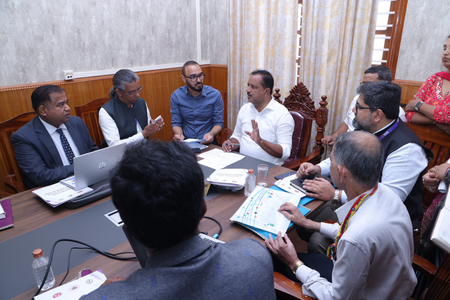
Bengaluru, Sep 22 (IANS) Karnataka Health and Family Welfare Minister U.T. Khader on Tuesday launched the Karnataka State Multisectoral Action Plan for Salt Reduction and Promotion of Healthy Dietary Habits, aimed at reducing excessive salt consumption and strengthening efforts to prevent non-communicable diseases (NCDs) across the state.
The action plan was launched during a Technical Advisory Group (TAG) meeting at Vidhana Soudha in Bengaluru. Former minister Dinesh Gundu Rao and Rajya Sabha MP Mansoor Ali Khan were also present.
The plan aims to reduce population salt intake by 30 per cent by 2030, in line with India’s global commitment, while promoting progress toward the World Health Organization’s recommendation of consuming less than five grams of salt per person per day.
The government said excessive salt consumption is associated with high blood pressure and increases the risk of stroke and other cardiovascular diseases. Indians are estimated to consume around 8–11 grams of salt per day, nearly twice the WHO recommendation.
Khader reaffirmed the government’s commitment to preventing NCDs through healthier diets and reducing dietary risk factors. He called for a State Steering Committee involving multiple departments to ensure coordinated and sustained action on healthier dietary habits.
Karnataka has already introduced measures addressing foods high in fat, sugar and salt (HFSS), which the government said would provide a foundation for strengthening healthier food environments.
The Technical Advisory Group, chaired by Bhagavan B.C., Vice-Chancellor of Rajiv Gandhi University of Health Sciences (RGUHS), has been constituted to provide technical guidance and support evidence-based measures on salt reduction and healthier dietary practices.
The group includes representatives and experts from the Department of Health and Family Welfare, Sri Jayadeva Institute of Cardiovascular Sciences and Research, NIMHANS, academic and nutrition institutions, and public health organisations.
Dinesha B., Director of Shri Jayadeva Cardiovascular Health Research Institute, participated in the technical deliberations. At the same time, Jnanesh Kamath, Joint Director, Health and Family Welfare, outlined the key priorities and proposed actions under the state action plan.
The plan focuses on salt consumption in three key settings: households, food consumed outside the home, and processed and packaged foods. Measures include reducing discretionary salt use, promoting healthier food choices, encouraging salt reduction in processed foods, strengthening dietary counselling through the health system, and supporting research on potassium-enriched low-sodium salt.
The strategy builds on existing initiatives in Karnataka, including salt-reduction measures under PM POSHAN, dietary counselling through Gruha Arogya, and dietary risk-factor counselling under the National Programme for Prevention and Control of Non-Communicable Diseases (NP-NCD).
The action plan was developed through collaboration between government departments, academic institutions, public health experts, development partners and civil society organisations, with technical support from Resolve to Save Lives and Vision for Social Development.
–IANS
mka/dan