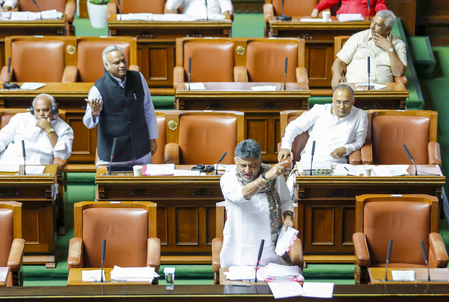
Bengaluru, March 26 (IANS) Deputy Chief Minister D.K. Shivakumar, who is also Bengaluru Development Minister, on Thursday outlined an ambitious roadmap to decongest Bengaluru, including the development of a township at Bidadi, elevated corridors, tunnel roads, and expansion of Metro services, while responding to a discussion on Greater Bengaluru in the Legislative Assembly.
Responding to BJP MLA S. Suresh Kumar’s suggestion to develop alternative cities outside Bengaluru, Shivakumar said the government has revived plans to build a township at Bidadi to ease pressure on the city.
He noted that similar proposals at Nandagudi, Solur, and Bidadi were dropped earlier, but the government has now decided to proceed.
He said that since Bidadi has adequate water facilities, the township will be developed there, adding that the proposal to build an AI City on 8,000 acres will be discussed in the Cabinet.
He also reiterated that a second airport for Bengaluru must come up in the southern region.
Addressing waste management issues, Shivakumar alleged that the previous government failed to effectively tackle the “garbage mafia.”
He said the current government has streamlined waste management contracts from 89 packages to 33 and brought them to the final stage.
While four sites were initially identified for waste disposal, the plan has now been finalised for two locations due to land constraints, including NICE land and an existing site at Doddaballapura.
On infrastructure, Shivakumar announced that a 109 km elevated corridor project will be launched soon. He also revealed plans to construct 300 km of buffer roads along stormwater drains, with partial land support from the Defence Ministry.
A double-decker road model, already implemented in Jayanagar, will be expanded to 40 km, with costs to be shared between Bengaluru Metro Rail Corporation Limited and the Bengaluru civic body.
Highlighting the scale of planned investments, he said projects worth Rs 1.5 lakh crore are being prepared to transform Bengaluru into a world-class city. The Metro network is set to expand to 350 km in the coming years.
Shivakumar acknowledged that traffic congestion remains a major challenge but argued that Bengaluru is often singled out despite worse conditions in cities like Mumbai, Hyderabad, and Delhi.
He pointed out that roads account for only 8 per cent of the city’s land, making expansion difficult, especially after the 2013 land acquisition law, which mandated higher compensation.
To address this, the government is pushing the Bengaluru Business Corridor project, for which 80 per cent of land acquisition for the first phase has been approved. Tenders will be invited soon, and the project is expected to significantly reduce congestion.
He also thanked HUDCO for offering Rs 26,000 crore in funding.
Additionally, Shivakumar emphasised the need for tunnel roads, stating that they are the only viable solution within the city.
He said construction could cost around Rs 700-800 crore per km, significantly lower than in other states, and would play a key role in easing traffic in the long term.
He said that earlier, when he was a Minister, Bengaluru’s population was 70 lakh, and today it has grown to 1.04 crore. The city now has 1.30 crore vehicles. He agreed that traffic congestion is a serious issue.
He added that in most major cities in the country, roads account for about 16 per cent of the total area and are relatively wider.
However, since Bengaluru is not a planned city, roads constitute only 8 per cent of its area. Within this limited 8 per cent, as many as 1.30 crore vehicles have to ply, leading to severe congestion.
–IANS
mka/dan