Jaipur Literature Festival opens Seattle edition with defence of reading, human imagination

Seattle, Sep 19 (IANS) The Jaipur Literature Festival opened its third Seattle edition with a defence of reading and human imagination, as writers, civic leaders and diplomats explored how stories can connect cultures in a city helping shape the age of artificial intelligence.
The gathering at the Seattle Public Library brought India’s literary traditions into conversation with the concerns of an American technology centre. Speakers discussed the preservation of memory, the importance of empathy and the place of books in children’s lives as technology changes how people learn.
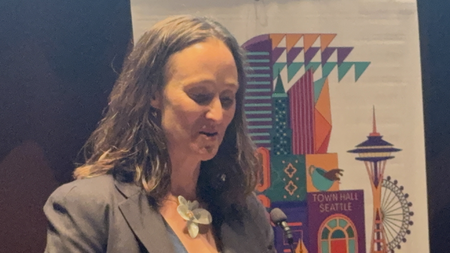
Seattle Mayor Katie Wilson welcomed the festival as a meeting of the Pink City and the Emerald City. She said the library was a fitting place to begin, describing it as a space that felt like the city’s living room.
“Seattle is at its heart a city of readers,” she said.
Wilson pointed to reading in neighbourhoods, classrooms, coffee shops, bookshops and libraries. She said JLF had quickly become part of Seattle’s cultural rhythm, bringing together writers, artists, scholars, students and curious readers from across the Pacific Northwest.
“Festivals like this one remind us that stories bring us together. They build bridges,” she said.
For Wilson, that connection was also about entering experiences beyond one’s own and imagining possibilities that might otherwise remain unfamiliar.
“In a room like this with open seats and open minds, we get to practice empathy,” she said.
The mayor raised a concern particularly relevant to Seattle: what the rise of AI might mean for reading, attention and the ability to write and think.
She acknowledged the city’s complicated position. Much of its economy was tied to the technology sector, including companies developing AI tools with potentially substantial benefits for humanity.
But, speaking as the parent of a three-year-old, Wilson said she worried about the effects on children growing up in a world very different from the one she had known.
She recalled how reading had helped her reach beyond her own experience and understand people living in another country or another period of history. The question, she suggested, was how children would develop those capacities amid technological change.
That made a public commitment to literature, writing and reading especially valuable, she said.
Wilson urged festivalgoers to attend sessions that interested them, meet someone new and trade book recommendations. She hoped they would carry something from the festival into their lives after leaving.
India’s Consul General in Seattle, Prakash Gupta, placed the gathering within another story of change: the expanding presence of Indian culture and the Indian American community across the United States.
Gupta recalled arriving in November 2023 and meeting festival organisers over coffee at a hotel. The consulate and the Seattle festival initiative were beginning their journeys at roughly the same time, he said.
Both sides were still working out how to establish themselves, but shared the determination to get started.
Watching JLF grow into a gathering at the Seattle Public Library had been a privilege, Gupta said. He described it as bringing together minds from India and Seattle.
He said the festival’s spread across American cities reflected the Indian American community’s growing size and its contributions to the country’s economic life.
Gupta also welcomed the participation of diplomats who had become authors. As a member of the Indian Foreign Service, he said, the festival offered opportunities to reconnect with senior colleagues through their writing.
His wider point was that art could reach people across geographical and cultural boundaries.
“Thank you so much for bringing the slice of India for this weekend to Seattle,” he said.
Sanjoy Roy, speaking for the festival, asked the audience to consider why literature, libraries and art mattered in a city so closely associated with technology.
He argued that art and cultural expression endured through the rise and fall of civilisations. Libraries, he said, preserved the record of human experience.
“These are institutions that hold memory,” Roy said.
He described stories as a force that brought people together and helped form communities. Literary gatherings offered opportunities to encounter different cultures, philosophies, food and ways of life.
Understanding those differences, he argued, could help counter ignorance. Reducing ignorance could, in turn, help confront hatred and violence.
Roy urged the audience to treat that effort as a responsibility shared by everyone.
“We have to step up to the table. We have to make a difference,” he said.
“This is a gathering of hope.”
Canadian novelist Yann Martel’s keynote explored why stories and imagination matter in uncertain times. He widened the discussion beyond books, pointing to storytelling through oral traditions, plays, poetry, songs, pictures and music.
Entertainment was part of a story’s appeal, he said, but did not exhaust its purpose.
Using the Trojan War narratives as an example, Martel discussed how stories could endure across centuries and shape a people’s understanding of themselves. Figures such as Achilles, Helen and Odysseus remained familiar even to audiences who had never read Homer.
The organisers, meanwhile, emphasised the community effort behind the festival. They thanked donors, sponsors, volunteers and partners for helping bring writers to Seattle and opening their work to new audiences.
Literary festivals, they said, transformed what often began as a private experience — one person reading a book — into a public conversation among strangers.
JLF Seattle forms part of the Jaipur Literature Festival’s international expansion from India. Its programme brings local, national and international voices together, with the Seattle launch following an opening gathering at a gallery the previous evening.
Martel is the author of “Life of Pi”, which won the 2002 Booker Prize. His keynote brought the perspective of a novelist known for exploring belief and imagination to a gathering focused on literature’s place in public life and the connections between Indian and international storytelling.
–IANS
lkj/rs