New Delhi, April 20 (IANS) India’s trade performance in Q3 FY26 reflected a mixed but resilient trend, with merchandise exports rising 1.6 per cent and imports surging 7.9 per cent, NITI Aayog said on Monday as it released its ‘Trade Watch Quarterly.’
Services exports grew strongly by 7.8 per cent, with relatively moderate growth in services imports, resulting in a sustained surplus that continued to anchor the overall external balance.
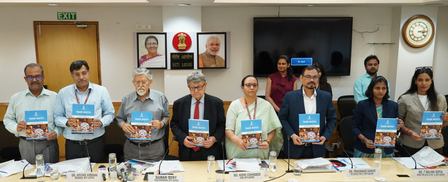
Suman Bery, Vice‑Chairman, NITI Aayog, released the latest edition of the publication for October‑December 2025 period here.
The thematic focus of the quarter’s edition was gems and jewellery, a critical pillar of India’s labour‑intensive manufacturing ecosystem. Excluding raw gold, the global market size was estimated at $378 billion in 2024, with India’s exports valued at $29.5 billion, accounting for 7.8 per cent of world exports, the statement said.
India’s export strength in the sector remains concentrated in diamonds and precious metal jewellery, which together account for over half of global demand around $207.3 billion.
In these segments, India has achieved a strong global presence, with exports of $26.7 billion, reflecting its established role as a global processing hub driven by value addition in imported raw materials, with Surat emerging as the world’s largest cutting and polishing hub, the statement noted.
NITI Aayog highlighted structural challenges including limited value addition due to a fragmented MSME base, reliance on imported inputs, credit gap due to lack of trust from financial institutions, skill and design gaps, and limited integration into global trading hubs.
The think tank called for diversification into emerging segments such as lab‑grown diamonds, improved access to finance and raw materials, investment in technology and skills, and stronger policy frameworks to addressing these challenges.
“In sectors such as gems and jewellery, aligning with evolving global demand, strengthening value addition, and addressing structural constraints is essential for maintaining competitiveness,” said Suman Bery.
The analysis highlighted that India’s trade structure in the sector is characterised by high product and market concentration. Exports are largely directed towards a few key markets, notably the United States, UAE, and Hong Kong, while imports are concentrated in a limited number of suppliers for raw materials.
–IANS
aar/pk