India-Uzbekistan have deep historical ties, partnership has immense potential, says President Mirziyoyev

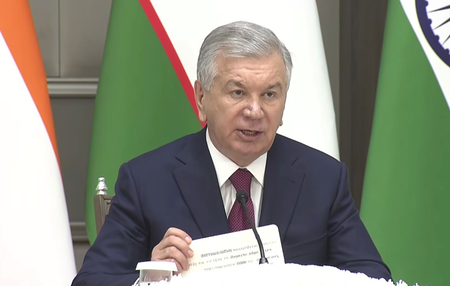
Tashkent, Aug 30 (IANS) Uzbekistan President Shavkat Mirziyoyev on Sunday said the people of Uzbekistan and India share “deep historical ties”, adding that it was “heartening to see these relations continuing to flourish today” and emphasising that the two nations, as strategic partners, have “immense potential” to further expand their cooperation.
Addressing a joint press meeting with Prime Minister Narendra Modi in Tashkent, President Mirziyoyev expressed gratitude to the Indian Prime Minister for his state visit and said the discussions between the two sides had resulted in significant decisions and provided a fresh direction to bilateral relations.
“The direct and substantive discussions we held today bear witness to the deep friendship between us and our status as strategic partners with immense mutual potential, a partnership that holds great influence on the global stage,” he said.
The Uzbek President said that the two sides discussed a wide range of possibilities and held detailed deliberations across different sectors, while also working towards formulating a roadmap that would guide bilateral cooperation in the future.
“We are delighted by the progress India has made in digital innovation, artificial intelligence, and startups, positioning itself as a global leader in sustainable development. We intend to align our broad-based cooperation with these advancements. We have closely reviewed our progress to date and set new objectives. I reiterate our commitment to adopting a roadmap covering all these areas,” he said.
President Mirziyoyev said India-Uzbekistan relations had reached a new level and had now evolved into a Comprehensive Strategic Partnership, reflecting the growing depth and breadth of cooperation between the two countries.
“We have established a dedicated mechanism to ensure the full implementation of the agreements reached. Regarding trade and economic cooperation, we have decided to deploy dedicated teams to work on these matters,” he said.
He further said the two sides discussed various issues during the past two days and put mechanisms in place to ensure the effective functioning of frameworks overseen by the Foreign Ministers of both countries.
“We also discussed issues that will allow us to reach new horizons, goals we can achieve through close coordination with our teams. This is particularly relevant to investment projects undertaken by leading Indian companies. During our discussions, we will also identify activities for the Inter-Governmental Joint Commission,” he added.
During the discussions, President Mirziyoyev said both countries had identified new areas where they could make full use of their existing potential and further strengthen bilateral cooperation.
He said India and Uzbekistan were looking to advance cooperation in several key sectors, including energy, culture, critical minerals, pharmaceuticals, jewellery and agriculture, with dedicated roadmaps planned for each area.
“We will prepare roadmaps for each of these sectors; specific teams from India will visit here, and our teams will travel to India, enabling us to clearly define our objectives in these fields. Our relationship in the space sector is also crucial for further strengthening people-to-people ties,” the Uzbek President added.
India and Uzbekistan would continue to support each other on important international platforms and work together through forums including BRICS, the Non-Aligned Movement, the Global South and the United Nations, he added.
Reiterating the historical connection between the two countries, the Uzbek President said there were “deep historical ties” between the people of Uzbekistan and India and that it was “heartening to see these relations continuing to flourish today”.
“Currently, four Indian universities are operating here, and the Lal Bahadur Shastri Centre for Indian Culture and the Mahatma Gandhi Centre are doing excellent work,” he said.
President Mirziyoyev said measures aimed at facilitating travel between the two countries would further strengthen people-to-people contacts and encourage greater interaction.
“Furthermore, the 30-day visa-free regime we have adopted, along with the promotion of direct flights, will enable more people to travel between our countries. We are formulating a comprehensive roadmap to implement all the agreements we have reached. The responsible officials will develop specific roadmaps, and my brother and I have agreed to personally oversee this process,” he added.
–IANS
sd/vd