
India launched 20 satellites, 12 launch vehicle missions in last 3 years: Jitendra Singh

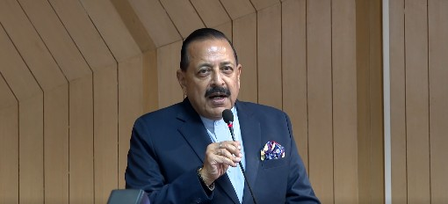
New Delhi, July 23 (IANS) India has successfully launched 12 launch vehicle missions, 11 national satellites and nine satellites for international customers in the last three years from July 2023 to June 2026, Minister of State (MoS) for the Department of Space, Jitendra Singh told the Parliament on Thursday.
Some of the significant milestones achieved during the period include India becoming the first country to successfully carry out soft-landing near the South Pole of the moon through the launch of Chandrayaan-3 Mission and the country launching its first solar observatory mission, Aditya-L1, on polar satellite launch vehicle (PSLV).
The milestone of 100 launches from India’s spaceport at Sriharikota in Andhra Pradesh was also achieved during this timeframe and India became the fourth country to demonstrate docking and undocking in space through the SPADEX (Space Docking Experiment) mission.
Besides, India launched the heaviest satellite to Geostationary Transfer Orbit (GTO) from its soil through the CMS-03 mission using LVM3 launch vehicle, MoS Singh said in a written reply in the Rajya Sabha.
The Department of Space has developed and operationalised four launch vehicles till date i.e. PSLV, GSLV, GSLV MkIII and SSLV, which are being utilised to launch satellites for earth observation, communication, navigation and space science and exploration along with commercial launch services for national and international customers, the MoS added.
He also said that the Union government has approved the establishment of Third launch pad at Sriharikota for the Next Generation Launch vehicles of ISRO and also to function as a standby for the Second launch pad at Sriharikota.
The SSLV Launch Complex (SLC) in Kulasekarapattinam of Tamil Nadu is also being developed as India’s second rocket launch site, in order to cater to the launches of Small Satellite Launch Vehicle (SSLV) along with launches by private space start-ups and non-governmental entities.
The existing two operational pads at Satish Dhawan Space Centre (SDSC) SHAR in Sriharikota i.e., First Launch Pad & Second Launch Pad along with the upcoming Third Launch Pad and SSLV Launch Complex provide sufficient launch capacity.
In order to strengthen India’s launch infrastructure and support the growing participation of Non-Government Entities (NGEs) in the space sector, the Union government has also introduced several enabling measures. These include allowing NGEs to establish temporary test facilities within ISRO premises, providing them with access to critical infrastructure and significantly reducing the time and cost associated with developing and validating launch systems.
“In parallel, the development of the second launch complex at Kulasekarapattinam is progressing steadily. Once operational, this facility will substantially enhance the country’s launch capacity, particularly for Small Satellite Launch Vehicles (SSLVs), improve launch frequency and provide greater flexibility to meet the increasing demand for commercial launches,” the Minister said.
In addition to infrastructure development, IN-SPACe has introduced several policy reforms and incentive schemes to promote innovation, indigenous technology development, and private sector participation.
These initiatives include financial support for startups and MSMEs, streamlined authorisation processes, skill development programmes, technology commercialisation, and the promotion of space manufacturing clusters to strengthen the domestic supply chain. Together, these measures are fostering a vibrant and globally competitive Indian space ecosystem
MoS Singh also highlighted that NewSpace India Limited (NSIL) has generated a revenue of Rs 447.43 crore through the launch services in 2024-25 which was more than twice that of the corresponding figure of Rs 218.21 crore for 20230-24.
IN-SPACe has also developed a strategic roadmap to expand India’s share in the global space economy. Under this vision, India’s space economy is targeted to reach $44 billion by 2033.
–IANS
sps/khz