

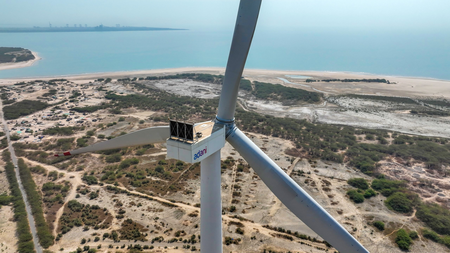
New Delhi, Nov 18 (IANS) India’s wind energy capacity has more than doubled over the past 12 years from 21 GW to 59.20 GW, marking the country’s transition towards a cleaner and more sustainable energy future, according to an official factsheet issued on Wednesday.
India is ranked 4th globally in installed wind power capacity, which accounts for approximately 19.8 per cent of the country’s total installed renewable energy capacity of 299.25 GW.
India’s estimated gross wind power potential is 695.5 GW at 120 metres and 1,163.9 GW at 150 metres above ground level. The country’s vast wind resource base provides a strong foundation for achieving 100 GW wind capacity by 2030 and 156 GW by 2036.
Most of the country’s assessed wind potential at 150 metres is concentrated in eight high-resource states — Rajasthan: 284.2 GW; Gujarat: 180.8 GW; Maharashtra: 173.9 GW; Karnataka: 169.3 GW; Andhra Pradesh: 123.3 GW; Tamil Nadu: 95.1 GW; Madhya Pradesh: 55.4 GW; and Telangana: 54.7 GW.
More than 900 wind-monitoring stations have been installed nationwide by NIWE to map wind resources and identify high-potential sites for wind energy development. Wind potential maps have been developed at 50 m, 80 m, 100 m, 120 m, and 150 m hub heights.
Government priorities focus on expanding wind deployment, offshore development, and grid modernisation. These are supported by targeted schemes, financial incentives, and regulatory reforms.
The government has set up Rs 6,853 crore Viability Gap Funding (VGF) for 1,000 MW of offshore wind projects, comprising 500 MW each off the coasts of Gujarat and Tamil Nadu.
A 500 MW pilot project was launched under the Contracts for Difference (CfD), which is a mechanism designed to reduce price volatility and provide revenue certainty to renewable energy developers.
Other steps undertaken by the government include the constitution of a Task Force in January 2026 to address regulatory, land, transmission, and implementation challenges and green energy open access rules have been introduced to facilitate direct procurement of renewable power by industries.
Besides, an Approved List of Models and Manufacturers (ALMM) is being implemented while transparent bidding guidelines, and late payment surcharge rules have strengthened investor confidence.
–IANS
sps/na